Showing posts with label National Gallery. Show all posts

Friday, 13 November 2015

Ten Minute Talk: Wilkie's Young Woman at a Prayer Desk


Young Woman at a Prayer Desk, 1813
David Wilkie 
The National Gallery, Bought 2014

This is just the second painting to enter the National Gallery's collection, after Raeburn's The Archers. It is also one of the Gallery's most recent acquisitions, bought with a genourous gift left my Marcia Lay, a Birmingham teacher.

The Painting depicts Augusta Phipps, daughter of the 1st Earl Mulgrave. She looks out at us in her vulnerable position at her prayers as though we have interrupted this private moment. The tiny, intimate portrait was commissioned directly from the artist and has an incredible melancholy as Augusta died later that year.

Wilkie is one of Scotland's most eminent painters. Inspired in his early career by great Dutch masters, his paintings always capture the character of those in his paintings. His first great work, Pitlessie Fair was painted when he was just 19 years old. It draws on the work of greats such as Brueghel to depict an action packed market day and all of the associated commotion. It is packed with people buying and selling, gossiping, eating and drinking and there's even a urinating dog. As well as the commotion though, Wilkie captures the character of each individual. 

Pitlessie Fair, 1804
David Wilkie
National Galleries Scotland

Following this painting, Wilkie's career exploded. He was trained at the Royal Academy, follows Lawrence in becoming the King's Painter and Raeburn's in becoming the King's Limner in Scotland, to George IV, in 1830, followed by a knighthood in 1836, famed and favourited for his vast scenes and grand portraits.

It is in this tiny Vermeer-esque piece however, that his skill for details - the carpet is exquisitely executed, reminiscent of early Netherlandish realism - and capturing a moment with the sitter is really rather expertly shown.

Hear more in November 2015 Ten Minute Talks- Room 30, Friday's in November at 4pm

http://www.nationalgallery.org.uk/paintings/david-wilkie-a-young-woman-kneeling-at-a-prayer-desk


Tuesday, 11 August 2015

TEN MINUTE TALK: Degas' Young Spartans


National Gallery http://www.nationalgallery.org.uk/paintings/hilaire-germain-edgar-degas-young-spartans-exercising
Degas is best known as a painter of everyday life, who mastered a great range of media from oils to pastels.

This painting, however exemplifies Degas working within the tradition of historical painting; a much more mainstream and traditional subject taught at the academy at the time. Probably based of Plutarch's The Life of Sparta, the scene is the ancient Greek state of Sparta, with Mount Taygetos in the background, the legislator Spartan in the middle ground and the foreground is occupied with a  group of semi-naked and naked adolescents.

Sparta was a state obsessed with phyical perfection and so Degas occupies the picture space with these stretching posed youths, showing off their physical capabilities. So obsessed they were, that any inferior infant would be thrown off Mount Taygetos.

Whilst the subject would have been recognisable as traditional, the method Degas has employed is not. His brushwork is robust, but the paint is kept dry, giving a frieze like texture to the painting. The landscape orientation adds to this effect, showing Degas reference to the frieze objects of Classical civilization, as well as his knowledge of the stories. In addition, classical modelling and beauty is lost in this work and the youths appear more similar to 19th-century 'Montmartre types' rugged street children, something which has in the past drawn criticism.

A social history reading of this painting, put forward by Carol Salus, explains the composition of the group of youths as an investigation of Spartan courtship rites, rather than wrestling which is more commonly accepted by art historians.


Friday, 9 May 2014

Surprise! Rousseau's Tiger


The dense, sodden vegetation in the colourful foreground of this painting is stark and bright against the heavy, overbearing, thunderous sky. The more you look, the more you can feel the humidity of the rainforest, the painting not only looks like a jungle it entices you to feel the jungle around you. The question is that if the surprise, is the tiger surprised by the lightning, are we surprised by the tiger or are the hunters, hidden from view but suggested by the artist, surprised at becoming prey?

This oil was painted in 1891 by Henri Rousseau and was his first jungle painting, a genre which has become synonymous with his name. 

Rousseau was born in the market town of Laval in North West France in 1844. Much that is known about his life is shrouded in doubt, as he often lied about his experiences and jobs to impress his friends. What we can be certain of is that he enjoyed a normal family life and was educated in school until the age of 17. After this comes the lies- notably being forced to join the army when he was caught stealing money and cash from his job as a law clerk.

Following the success of his jungle scenes in later life, Rousseau would describe how his experience in Mexico as a regimental bandsman inspired the exotic flora and fauna, but Rousseau never left France.

He moved to a newly modernised Paris in 1868 and quickly married Clèmence Boitard. He had a child with her, who died in infancy and the marriage did not last.

He began working as a toll station inspector in 1871 and continued in the profession until he retired. Another case of Rousseau bending the truth to his advantage can be seen here. "le Douanier" means customs inspector and, dispute Rousseau readily adopting this nickname, it was a rank he never reached.

In 1880 Rousseau's first signed painting appear, depicting Parisian life and portraits of friends. He taught himself to paint and his own unique style is obvious. He allowed himself to be considered a naive painter, but he was certainly aware of academic technique and old master paintings, having taken out a copyist permit for the Louvre in 1884.

Surprise is Rousseau's first jungle painting. The vegetation is based on accurate knowledge and representation of flora Rousseau would have seen on trips to the Botanical Gardens in Paris. At the front he paints agave leaves and pointed euphorbia, a rubber plant, American fan palms and a French pinnate surround the tiger, whilst a java fig and India Bo Tree overhang the scene. The fact that all of these plants live naturally across three continents suggest again that the scene is based on the France that Rousseau saw, rather than the Mexico he lied about living in.

What is incredible though, is his accurate representation of the plants and instinctive use of colour, yet the dream-like quality he archives in his execution of the scene. He even said that "when I step into these hot houses and see strange plants from exotic lands I feel as if I have stepped into a dream".

Rousseau was consider naive by contemporary audiences and laughed at at the salon des independents where he exhibited but the avant-garde held him in high esteem. If you look closely at the original, the translucent, opalescent glaze he has applied in diagonal grey and white oil streaks across the canvas show his complex understanding of painting and his incredible skill. Again, 'naive' is probably a label the incredibly self assured artistes promoted himself.

Indeed, he used his paintings as evidence to win his acquittal when tried for fraud in 1907. So pleased was his friend Picasso, he held a soirée in honour of the occasion and claimed Rousseau was the greatest modern artist if his time.

Testimony to this are Weber's New York exhibition of his work just one year after his death.

Whilst Rousseau was a fraud and a chancer in so many ways, in so many others he was an artistic heinous who used prejudices and stereotypes to his great advantage. He would be incredibly smug to see his once-ridiculed painting hanging in such high esteem in the National Gallery today.

Thursday, 13 February 2014

Ten Minute Talk: Saint Margaret of Antioch, by Zurbaran


Today I will be giving a Ten Minute talk at the National Gallery in Room 30 on this wonderful Zurbaran Painting.

At the height of his career, Franciso de Zurbaran was a freeman of Seville, living there with his second wife, three children from his first marriage and eight servants. He had been invited by the town elders as they thought his distinction as a painter with dramatic Baroque flair and such daring chiaroscuro effect could boost the reputation of the town. Not only was that true, but it also boosted Zurbaran's career and he was appointed as court painter to Philip IV Spain.

Saint Margaret of Antioch was painted by Zurbaran in the 1630s, just before his career really took off. This makes it a rare and exciting painting. Zurbaran's most famous saint paintings are painted in series, such as the magnificent series of the 12 Sons of Jacob in the collection at Aukland Castle, and are painted by studio assistants, rather than solely by the artist himself.

Saint Margaret of Antioch was a peasant girl who lived in the third century in Antioch, a small town in Byzantium, modern-day Turkey. Her mother had died in her early childhood and she was raised by her shepherdess nurse, hence Zurbaran's inclusion of a crook in the painting. To aid identification further, Zurbaran dresses the girl in his painting as a Spanish peasant girl, her bag (an alfornja) and hat drawn from life; she doesn't appear ethereal, as Zurbaran's saints often do, she is a real girl. Saint Margaret's  declared her faith with a vow of chastity, which ultimately cost her her life. When proposed to, by a Governer of the Roman Empire, Margaret refused and was taken away for torture. One of her martyrdoms was to be fed to the devil disguised as a dragon. Her purity saved her and she burst from it's belly. This is symbolised by the beast crouching behind her in Zurbaran's painting. It is most unusual of Zurbaran's Baroque style to have depicted the saint as an ordinary, contemporary girl, with a tame dragon. The high drama and excitement of painting at this time would usually dictate a story of this magnitude be illustrated at crux of the tale, namely where Saint Margaret bursts from the dragon. This suggests it was painted at the patrons request. As she is the patron saint of childbirth (due to bursting from dragon) it could perhaps be intended as a tasteful wedding gift.

Despite his great fame and fortune, Zurbaran's style became rather unfashionable even during his lifetime, with the pastel tones and subtle lighting of Murrillo taking centre stage, and Zurbaran died in obscurity.

http://www.nationalgallery.org.uk/paintings/francisco-de-zurbaran-saint-margaret-of-antioch

Wednesday, 8 January 2014

Ten Minute Talk: Christ Blessing the Children, Nicholaes Maes


If you couldn't make my Ten Minute Talk at the National Gallery today, then you can read about the fab Maes painting here instead.

Nicholaes Maes is errornously best know as a successful pupil of the great Dutch master, Rembrandt. Indeed, research and publications pertaining to his work are often investigations meriting Rembrandt with being a great teacher.

Maes was born in Dordrect, the Netherlands, during the 80 Years War for Dutch independence from Spanish rule. It was a turbulent time, but one of increasing Dutch power; by the 1650s this was one of the richest, most powerful and influential nations. The Netherlands international trade, colonisation of land seafaring power made it the first successfully globalised nation. 

Independence from Spain, granted by King Philip II was granted in 1648. In addition to the power the country gained from this, the lives of ordinary people changed dramatically. Calvinism took over, making Catholic practice redundant. This religion's ideology is rooted in the truth of the word, taking the bible quite literally and living by the work of the scriptures. This was largely driven by Johannes Gutenberg's 1450 invention of the printing press, which increased book production by an unprecedented amount. Where as once a congregation relied on images of Christ and the Priest to tell the of the Bible under Catholicism, the Calvinist regime allowed them to read the bible for themselves. These new Protestant churches were sparsely decorated; huge halls of quite contemplation. For artists, this meant a shift in patronage, from the church to the middle class trader.

It can be supposed, given the size of the canvas, which appears to be two sheets glued together, that Maes' Christ Blessing the Children was indeed created for a wealthy merchant. Certainly, he never created anything as large after this piece. What is certain is that the subject matter, a highly provocative religious sentiment, was not typical of Maes. This could either point to a less than ideal patron early in Maes' career, or his dedication to the style of Rembrandt.

What we see here is a very clever and subtly persuasive depiction of Christ Blessing the Children, Matthew 19, 13:15. "Then people brought little children to Jesus for him to place his hands on them and pray for them. But the disciples rebuked them. Jesus said, “Let the little children come to me, and do not hinder them, for the kingdom of heaven belongs to such as these.” 

This text was used by Calvinists as reason for infant baptism, and allowed them to argue against the Lutharian view that only those capable of making the choice should be baptised into the Kingdom of Heaven. Their dedication to the word of the Bible as absolute truth, meant Calvinists did baptise their children, they thought it would relieve them from Original Sin, which Maes hints to with the girl in the foreground clutching the apple. 


Other characters in this painting help to tell a story. Later in his career, Maes would focus his work on portraiture and satirical depictions of everyday life. His interest in people and relationships, as opposed to a devout religious painting, is obvious here in the look of the crowd. Whilst Christ is portrayed as an ethereal, idealised being, the crowd are rugged and ordinary. Maes has clearly drawn from life to capture the essence of the working class crowd he depicts. Clever techniques he has employed are painting a strong middle ground of people, then filling in gaps behind them with a mere suggestion of an eye or an arm; it looks a lot busier than it is. In the top left corner, we can see a child clutching a peculiar object.


Given Maes' interest in people's lives, this is likely a spool of wool, which shows that the crowd is made up of Dutch spinners. In this traditional set up the father would be the weaver and work the loom to create wool cloth, the women or 'spinsters' would spin woollen yard and the infants were responsible for 'carding' or combing out the wool fibres from the raw wool. In their haste to run to Christ, this family has brought their work with them. In is another hint of the urgency and importance of becoming part of the church.

This is Maes' only large scale religious painting. When the National Gallery first acquired it, they did so as a Rembrandt, due to Maes' careful copying of his master's work. It is ironic, perhaps, given he is mainly remembered as Rembrandt's pupil, that Maes became famous and popular only when he moved away from Chiarascuro, murky, reds of Rembrandt to the fashionable, bright Baroque style he chose later in his career.


Friday, 15 November 2013

TEN MINUTE TALK: Joseph Wright 'of Derby'


The title of this painting is purely descriptive and the artist has made no attempt to conceal the subject from us. As we look at the painting, the experiement in question dominates the picture space, it is right in the centre of the composition with both the bird and the air pump being immediately obvious. We can also see a group of people engaged in various ways with each other and the experiment they are watching. It is also immediately obvious that it is night time as we look into this scene; the moon is shining brightly into the candlelit room.


The airpump was invented in the 1650s by a German scientist named Otto von Guerick. It was an expensive piece of apparatus that would pump air out of whichever sealed chamber it was connected to, producing a vacuum. Due to its cost, the air pump was not readily available. The Irish Scientist Robert Boyle was very interested in experimenting with it and since he was the son of the Earl of Cork, the cost of the air pump was no obstruction to him. He experimented widely with the pump and in 1660, 9 years after he had established the Royal Society with 11 others, he published New Experiments, a volume detailing 43 experiments on the effects of different air pressure on various phenomena such as combustion, magnetism and even living creatures.


About a hundred years after Boyle’s experiments, when Joseph Wright painted this picture, air pumps were readily available and lectures and scientists would use them in public demonstrations, at fairs and in town halls and even, as Wright shows us in his painting, for middle class private audiences in their own home.


The experiment with the bird in the air pump was often the centrepiece for such shows, but was horrific to watch. Boyles book details the experiment and describes the bird’s slow suffocation as similar to watching poultry have its neck wrung.


This questions the importance of scientific discovery over the sanctity of life. Should the bird die so that people can learn about air pressure? Wright cleverly uses the audience of the experiment to raise society’s anxieties at the time over the impact of science.


The age of enlightenment, or the long 18th-century as it is sometimes known- refers to the period of rational and more secular thinking, teamed with scientific discover that occurred throughout the 1700s. Philosophers such as Locke would not accept any truths other than those which could be empirically proven to be true. He relied on what could be touched and seen. Scientists such as Isaac Newton were working to create theories that could be tested using science. People were worried about the impact of this on their lives and also on religion. Wright paints the young girls looking anxious for the bird, whilst the gentleman in the foreground comtemplate the outcome of the experiment. One can be seen timing how long it will take for the bird to die.


Wright has picked a crucial moment in the experiment. If it continues the girls’ fears will be realised and the bird will die, but if the experiment ends, then the bird will live. Write heightens the drama by giving the audience no real clue as to which outcome to expect. The bird pictured is a rare and expensive cockatoo. Usually a sparrow would have been used for such an experiment, so that maybe hints at the bird’s survival. However, we can also see the boy on the far right holding a pulley rope. It is impossible to tell whether this lowers the cage for the bird to be returned to it, or shuts the curtains on nature; blocking the natural light of the moon, leaving only illumination by science and a dead bird!


Some scholars have also hinted that this bowl of liquid holding a skull, through which the solitary candle can just be seen, acts as a vanitas, a technique of using objects which hint at the inevitability of death. Others have drawn attention to the image of the holy trinity in the painting made by the father character, the scientist and the bird. It is similar in composition to a holy trinity with Christ as the caring figure, tending to humans, the dove as the holy spirit and God the father, looking out at us and pointing to heaven.


In his looking out the figure of the scientist invites us in to the painting. Should the bird live or not, he appears to ask us. Testing on animals for scientific gain still causes contention between various religious, animal rights and scientific groups today.


Some art historians are less interested in the socio-political readings of the painting and focus on Wright’s technique. The dramatic subject lends itself well to the dramatic light in which Wright has made this painting. The stark contrast between light and dark, known in art historical terms as ‘chiaroscuro’ gives a definite realism to the painting. If we compare it to the Gainsborough just next to it, we can see how the painting is brought to life by the sharp contrasts in light and shadow.


I personally think that the fact Wright quite literally used science to enlighten the audience shows us that this painting does reflect the interest in science at the time it was painted.


Wright is referred to as Joseph Wright of Derby quite simply because that was the part of England he was from. He also studied in London, became an associate of the Royal Academy and painted portraits and landscapes in Liverpool and Italy. He had famous patrons such as Richard Arkwright and Josiah Wedgewood, showing him to be a thoroughly modern man. He was also famous for painting conversation pieces, popular in the 18th century with the middle classes, these paintings were portraits of recognisable people in real settings. Although Wright never claimed this painting was a conversation piece nor identified any of the characters in it, if you go through those doors into room 35 and turn left you will see a portrait of Wright’s friends Mr and Mrs Thomas Coltman who I think look suspiciously like the young couple here, who are a lot more interested in  each other than this experiment.


Friday, 28 June 2013

Saints Alive

You're never left with nothing, you're left with minus. In conversation with Michael Landy


Michael Landy rose to fame with as a YBA in the mid-1990s with his installation 'Break Down'. In a disused C&A department store on Oxford Street- a victim of financially hard times in the centre of consumerism- Landy systematically documented his every possession, then destroyed every single one. This radical art work ridiculed possession but also got the the heart of sentimentality; his mother was too upset to stay and watch her wedding photographs be destroyed an had to be escorted of the premises.

After a long series of similar wild installation pieces, then a significant absence from the scene whilst Emin is ever the tabloid favourite and Hirst is making millions, Landy has crashed back with his Saints Alive exhibition at the National Gallery.


Following a succession of artists such as Bridget Riley, Ron Mueck and Peter Blake, Landy was asked to take up residency at the gallery. Weird for him in many ways by his own admission as he has neither painted before nor had a full time job before.

What struck Landy most profoundly about the collection he was asked to respond to was St Catherine's wheel. He found 13 of these in paintings and wondered what they were and why they weren't highlighted. This spurred him on to discover the stories behind the saints, unlock the symbols to reveal the tragic stories of their martyrdom. 

Landy said that You're never left with nothing, you're left with minus in relation to the debts he rang up following the destruction. But it is a profound idea that has resurgence in Saints Alive. The stories of the saints are today largely forgotten, St Apollonia pulling out her teeth to rid her of her cursed beauty, St Francis if Assisi inherited the wounds of Christ, the stigmata. Even though they are forgotten, we are left with paintings not nothing and a largely secular society- a minus if you will- rather than nothing.

Landy's kinetic sculptures bring the stories of the saints to life for a 21st century audience. See doubting Thomas prodding the wounds of Christ and St Michael wrestle the devil. His main focus throughout the creation if these sculptures was the Catherine wheel. Originally he wanted to create a huge one that rolled around the gallery picking up visitors. At least that might have worked, most of Landy's sculptures in ironic Landy style keep breaking down and returning to the workshop. Whilst of course it was an eventual aim that these sculptures would break down- just listen to the racket as St Jerome beats his chest with a rock- I'm not sure even the artist anticipated the quite so frequent Break Down of his sculptures. Like he says, you're not left with nothing, you're left with minus, in this case an installation in constant need for repair.


Vermeer & Music


A popular and easy criticism to make of the Vermeer&Music exhibition on show at the National Gallery until 8th September 2013, is the distinct lack of Vermeer paintings. Certainly the show may be lacking in volume, but considering there are only 19 known Vermeer paintings in the world, five isn't so bad. Who can blame the gallery for using the snappy, big celebrity name of Vermeer, rather than simply calling it Music and the Golden Age of Dutch Painting, which would an altogether more apt title.

Overlook the poor titling however, and the exhibition is joy. The work if Vermeer and his contemporaries is incredibly noisy if you're willing to look closely enough and this exhibition, though extensive use of  musical instruments displayed alongside the paintings allows us to hear what has been silently captured in an image.

The Academy of Ancient music have teamed up with the National Gallery for this exhibition and are performing original 17th-century musical scores on original 17th-century instruments in the exhibition space. The overall effect of which is bewitching.

The concert, at the time Vermeer was painting, did not refer to a large dance hall, but simply a gathering of friends in the home who would play music together. The lead would strike up his instrument and play the first few notes of basso continuo, which in baroque music means bass-line. This carries melody and the rest is improvisation. What this means is that no singular performance if the same piece will ever be the same. The selection of vanitas still lives displayed in the first room of the exhibition really capture this idea of music as a moment, ephemeral, to be savoured but cannot be kept.

More intimate than a concert, was the music lesson. Rarely could young men and women spend so much time alone together than under the guise of musical tuition. 

Johannes Vermeer's The Music Lesson from the Queen's Collection captures perfectly this intimacy. Whilst it seems innocent enough on first glance, the artist reflects for us in the mirror above the virginal the young woman plays, a tender exchange of a loaded glance between tutor and pupil. The warm sunlight streaming through the sash window engulfs the young pair in a balmy, amorous glow. If further and direct allusion to the pairs romantic involvement were needed, it can be read directly from the virginal 'MUSICA LETOTIAE COMES MEDICINAL DOLORIS', music is the companion of joy, the medicine of sorrow. 

This exhibition has also provided the National Galley the opportunity to show off the work of the scientific department. On loan from Kenwood House, Vermeer's Guitar Player has been thoroughly examined whilst in the National Gallery. The findings show that it is still on its original canvas and from the same period as Woman Seated at a Virginal and A Young Woman Standing at a Virginal from the National Galleries own collection.

Seeing these three paintings if similar subject and size displayed together is a real and rare treat. Whilst the two paintings with virginals show the young woman engaged both with her craft and the viewer- the women peer out at us, placing us in the position of tutor and therefore probably love interest- the guitar player glances away. Her attention has been caught elsewhere and we are left to wonder what we can't see rather than dwell on what we can. What this display of the three paintings reveals therefore is Vermeer's acute understanding of both the relationship of tutor an pupil, and of painting and viewer. His pictorial devices that make us want to cross the yard and climb through his lit windows to the woman inside, have also made us want to strike up the harpsichord and join in the lesson.

This exhibition is alive. There's so much energy and noise and romance that its nice to catch a break. My favourite painting in the exhibition isn't a show-stopping Vermeer, nor a unique ivory lite, but a tiny oil painting by Carel Fibritus. This tiny canvas depicts a market square in the early morning. The vendor can be seen yawning just behind his instrument wares. Shuffling along the dusty street alongside the gentle water of the pond are a mother and daughter walking together. If you listen carefully the peace is broken only by the merry chiming of the church bells. In this case, depicting silence is as powerful as depicting music. 

Wednesday, 31 October 2012

Seduced by Art: Photography Past and Present


This exhibition is everything it promises and more. The tag line, simply 'photography past and present', underplays the vast array of questions raised in this dazzling showcase of old master paintings and photographic responses to them.

Flowers have long been used by painters in Vanitas pieces; visual reminders of the immediacy and inevitability of death. In photography this melancholy is pushed further. Sam Taylor Wood's iconic video installation of a plate of rotting fruit is both beautiful and repulsive at once; death creeps over the  fruit at a startling rate which compels the viewer to watch despite their knowing the inevitable is on its way. Sarah Jones' over-exposed photographs of rose bushes use the bight flash of the camera to block the daylight from the park the picture was taken in and suspend the roses in time and in blackness. Like picking a flower plucks it from reality and forces it into a bitter-sweet destiny of love and death, taking a picture, in Barthes is to be believed, captures reality in a cruel way so that the past always has the power to live beyond reality and be truly haunting.


Thomas Struth's long exposure photographs of families echo Victorian photographs where people didn't smile largely because posing was so boring. With Struth's work the personality of each sitter shines through and we are captivated by his images.


Ironically photography is banned in the National Gallery, to protect the original images. A photography exhibition where images such as Struth's National Gallery are displayed, recalls issues of Benjamin's aura. Whatever your thoughts on the power of the original, this exhibition is well worth seeing for yourself.


Wednesday, 10 October 2012

Richard Hamilton RA; The Late Works


Richard Hamilton RA; The Late Works

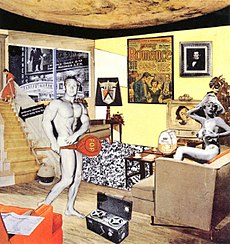
Richard Hamilton's public image is about to be blown apart in this National Gallery exhibition of his later art work. Hamilton became a household name in the 1960s as the father of Brit Pop. No, not for leading Oasis to fame and glory, but for leading British Pop Art. Cut from scraps of newspaper and comic strip, his What is it Makes Today's Home So Different, So Appealing? features all manner of domestic cult icons; Mr Universe, the television, the Hoover, the Lounge.


Whilst these later pieces address some of the same issues, rather than relating to false icons, Hamilton's pieces address religious iconography and the representation of it. In The Saensbury Wing Hamilton sets the traditional female nude free in the National Gallery; free to wonder amongst the traditional, Christian paintings that are hung in the gallery's Sainsbury wing. It challenges the relationship between traditional art and traditional religion, not least because Hamilton employs the image from his own triptych of IRA imagery.

The controversial images concentrate much of their efforts on placing a very real, rather than traditional, nude in seemingly trivial, domestic spaces. On closer inspection the nude is the Virgin at the point of the annunciation; only she receives the word of God over the phone. These images raise the question of how, if ever, it is appropriate to represent such a topic.

Marcel Duchamp is an omnipresent force driving these later works. Similar to collage, the digital print picks up where Dada left off and questions what art is. Can you make a painting if you digitally manipulate a photograph and print it out? Hamilton does.

The exhibition is melancholic; it is sad to think that Hamilton knew both this exhibition and his own death were imminent and I think this poses some interesting questions when viewing the exhibition. The works are cold and clinical, they aren't particularly nice to look at, but nonetheless they are captivating and draw you in.


Thursday, 19 April 2012

National Gallery

I went here today. But I forgot to take a picture so this is one from Christmas! Sadly it was so rainy that this is basically what it looked like. The new office..?