
Richard Hamilton RA; The Late Works
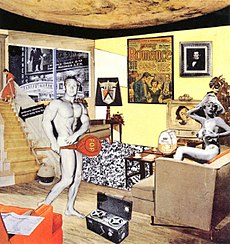
Richard Hamilton's public image is about to be blown apart in this National Gallery exhibition of his later art work. Hamilton became a household name in the 1960s as the father of Brit Pop. No, not for leading Oasis to fame and glory, but for leading British Pop Art. Cut from scraps of newspaper and comic strip, his What is it Makes Today's Home So Different, So Appealing? features all manner of domestic cult icons; Mr Universe, the television, the Hoover, the Lounge.

Whilst these later pieces address some of the same issues, rather than relating to false icons, Hamilton's pieces address religious iconography and the representation of it. In The Saensbury Wing Hamilton sets the traditional female nude free in the National Gallery; free to wonder amongst the traditional, Christian paintings that are hung in the gallery's Sainsbury wing. It challenges the relationship between traditional art and traditional religion, not least because Hamilton employs the image from his own triptych of IRA imagery.
The controversial images concentrate much of their efforts on placing a very real, rather than traditional, nude in seemingly trivial, domestic spaces. On closer inspection the nude is the Virgin at the point of the annunciation; only she receives the word of God over the phone. These images raise the question of how, if ever, it is appropriate to represent such a topic.
Marcel Duchamp is an omnipresent force driving these later works. Similar to collage, the digital print picks up where Dada left off and questions what art is. Can you make a painting if you digitally manipulate a photograph and print it out? Hamilton does.
The exhibition is melancholic; it is sad to think that Hamilton knew both this exhibition and his own death were imminent and I think this poses some interesting questions when viewing the exhibition. The works are cold and clinical, they aren't particularly nice to look at, but nonetheless they are captivating and draw you in.

The controversial images concentrate much of their efforts on placing a very real, rather than traditional, nude in seemingly trivial, domestic spaces. On closer inspection the nude is the Virgin at the point of the annunciation; only she receives the word of God over the phone. These images raise the question of how, if ever, it is appropriate to represent such a topic.
Marcel Duchamp is an omnipresent force driving these later works. Similar to collage, the digital print picks up where Dada left off and questions what art is. Can you make a painting if you digitally manipulate a photograph and print it out? Hamilton does.
The exhibition is melancholic; it is sad to think that Hamilton knew both this exhibition and his own death were imminent and I think this poses some interesting questions when viewing the exhibition. The works are cold and clinical, they aren't particularly nice to look at, but nonetheless they are captivating and draw you in.


