Thursday, 1 November 2012

Tim Walker; Story Teller


Today I had a bizarre encounter with a giant doll, snails that were bigger than me and a swan love boat parked on an indoor beach of lurid fake sand. Tim Walker, who graduated in 1994 and spent the early years of his career wasted as a newspaper photographer, has spent the last decade creating weird and wonderful worlds for fashion to inhabit. He doesn't just photograph fashion, he helps create it. That unobtainable, exaggerated fun we associate with this fickle world is played out in Walkers work. From pastel Persian cats, to models hidden under beds made of bones, he leads fashion into the realm of impossible imagination.

The current retrospective at Somerset House allows us to experience his magic first hand, his giant doll is as eerie up close as she is chasing models through the woods.


Happy Halloween

I received a call from my housemates as I was en route home last night- the lollies had run out- we needed more supplies. It was only 6pm! The trick-or-treaters were out in force in the Clapham area. I told her we would hide in the lounge at the back of the house and pretend not to be in, before instantly feeling guilty about it and detouring to the local corner shop for a selection of sweets. I was ever so slightly spooked when the cost of the random selection was £6.66. Devilish!

Getting in the spirit, we carved our pumpkins, joyfully answered the door to hoards of kids covered in fake blood and then embarked on a scary trip out. Our local Picturehouse cinema was screening The Shining, a cult classic I have never seen before. It wasn't too scary that I couldn't sleep, but I was pleased I'd shut the curtains before leaving the house!

Wednesday, 31 October 2012

Seduced by Art: Photography Past and Present


This exhibition is everything it promises and more. The tag line, simply 'photography past and present', underplays the vast array of questions raised in this dazzling showcase of old master paintings and photographic responses to them.

Flowers have long been used by painters in Vanitas pieces; visual reminders of the immediacy and inevitability of death. In photography this melancholy is pushed further. Sam Taylor Wood's iconic video installation of a plate of rotting fruit is both beautiful and repulsive at once; death creeps over the  fruit at a startling rate which compels the viewer to watch despite their knowing the inevitable is on its way. Sarah Jones' over-exposed photographs of rose bushes use the bight flash of the camera to block the daylight from the park the picture was taken in and suspend the roses in time and in blackness. Like picking a flower plucks it from reality and forces it into a bitter-sweet destiny of love and death, taking a picture, in Barthes is to be believed, captures reality in a cruel way so that the past always has the power to live beyond reality and be truly haunting.


Thomas Struth's long exposure photographs of families echo Victorian photographs where people didn't smile largely because posing was so boring. With Struth's work the personality of each sitter shines through and we are captivated by his images.


Ironically photography is banned in the National Gallery, to protect the original images. A photography exhibition where images such as Struth's National Gallery are displayed, recalls issues of Benjamin's aura. Whatever your thoughts on the power of the original, this exhibition is well worth seeing for yourself.


Friday, 19 October 2012

Night Paintings


Paul Benney; Night Paintings


Descending the grandeur of Somerset House from the luxurious Strand entrance, down the Stamp Stairs to the old workhouses and the Embankment side, is descending down to a less polished, more exposed part of the building. Stripped bare of oils on canvas, naval coats of arms and marble façades, the embankment galleries and lower-ground level perfectly complement Paul Benney's most recent show of works. Night Paintings are an eerie collection which document the artist's insecurities over what is just beyond the mirror. They transcend their surroundings; placed in Somerset House's old coal houses and and area aptly named Dead Houses, an underground passageway, where tombstones from Inigo Jones's demolished chapel have been laid to rest. 

The paintings are set to question religious iconography and challenge a traditional representations of such abstract forces. Benney doesn't intend to place religion in a contemporary setting, indeed he denies his work makes any political stance, setting him apart not only from traditional painters of icons, but also of modern artists who employ religious undertones. These paintings address our unconscious. Life-size figures of photographic realism reach out and apprehend us as we view them, beckoning us into a world we cannot see. The Tenant tries to touch you, to take you beyond what is real to where he is. We are confused and upset by this reaching, as though his figure seeks our help. Benney's innovative medium of oil and plastic resin makes the surface of the image seem penetrable; you almost want to jerk away from the paintings, scared you may get taken in.

Chandelier really gets to grips with the sense of nocturnal mystery. Suspended over a baron, unreal landscape is an elaborate lit chandelier. It hovers, somewhere between material and ethereal, lit and extinguished, perfection and smashed into thousands of shards. It's incredible a painting can hold you in such suspense. 

The defining piece in this exhibition has to be Snow in Jerusalem.Created from a photograph of the artist on a visit to the Holy Land, it makes this questioning of religion and art seem incredibly personal. Is it a vacation, or a pilgrimage? The snow has a temporal hold on a false reality that the artist, painted in a startling purple, is walking through to reach us at the end of the gravestone lined tunnel.

Sadly, its not all good. Pissing Death- a skeleton having a wee into a lake- is just aesthetically awful when lined up against some gems in the show. Whilst it is interesting to see a piece which harbours Benney's allegorical influences, the work of Goya and Velásquez is a far cry from such a crude allusion to the nature of death.

Benney's show is creepy, though provoking and completely insightful. The venue is completely fantastic and allows the paintings to feel like a part of something bigger, beyond the graves, beyond Somerset House and beyond the painter himself.

Wednesday, 10 October 2012

Richard Hamilton RA; The Late Works


Richard Hamilton RA; The Late Works

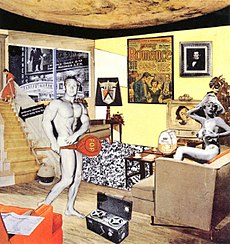
Richard Hamilton's public image is about to be blown apart in this National Gallery exhibition of his later art work. Hamilton became a household name in the 1960s as the father of Brit Pop. No, not for leading Oasis to fame and glory, but for leading British Pop Art. Cut from scraps of newspaper and comic strip, his What is it Makes Today's Home So Different, So Appealing? features all manner of domestic cult icons; Mr Universe, the television, the Hoover, the Lounge.


Whilst these later pieces address some of the same issues, rather than relating to false icons, Hamilton's pieces address religious iconography and the representation of it. In The Saensbury Wing Hamilton sets the traditional female nude free in the National Gallery; free to wonder amongst the traditional, Christian paintings that are hung in the gallery's Sainsbury wing. It challenges the relationship between traditional art and traditional religion, not least because Hamilton employs the image from his own triptych of IRA imagery.

The controversial images concentrate much of their efforts on placing a very real, rather than traditional, nude in seemingly trivial, domestic spaces. On closer inspection the nude is the Virgin at the point of the annunciation; only she receives the word of God over the phone. These images raise the question of how, if ever, it is appropriate to represent such a topic.

Marcel Duchamp is an omnipresent force driving these later works. Similar to collage, the digital print picks up where Dada left off and questions what art is. Can you make a painting if you digitally manipulate a photograph and print it out? Hamilton does.

The exhibition is melancholic; it is sad to think that Hamilton knew both this exhibition and his own death were imminent and I think this poses some interesting questions when viewing the exhibition. The works are cold and clinical, they aren't particularly nice to look at, but nonetheless they are captivating and draw you in.


Monday, 8 October 2012

You must be chalking

Before City of Westminster Council moved him on, this chap was having a great time chalking flags of the world on Trafalgar Square

Somerset House

Today I'm volunteering here. I really like the Nelson Stairs.