Tuesday, 10 December 2013

St Paul's Cathedral


There is no better time to visit the country's most important cathedral than at Christmas. sitting under the ordinarily superb dome whilst it's flanked by two impossibly large Christmas trees is just fabulous.

We took out an audio guide, which was wonderfully informative. The Old St Paul's was destroyed in the Great Fire of London in 1666. Redesigning the nation's church fell to the great Sir Christopher Wren, who was already busy changing the face of London with a collection of grand churches and buildings across the capital. With his signature Baroque elegance, wren's cathedral is just stunning. Whilst the outside is brilliant, it is the interior that sets it apart from others. In particular James Thornhill's frescos on the dome, depicting the life of St Paul, are impossibly brilliant. HOW did he get up their and paint them is all I could think whilst admiring them from the Whispering Gallery.

Even though it had already been a 257 step trak to this point, we were keen for the all-important view, so continued all the way up to the Golden Gallery, 528 steps up, to see it.


It is completely worth it!


Following a well earned tea and cake in the crypt, we stayed for a service of evensong, which was beautiful.


Walking home along Southbank


Saturday, 7 December 2013

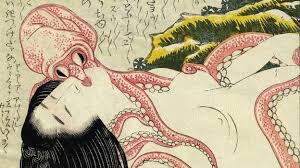
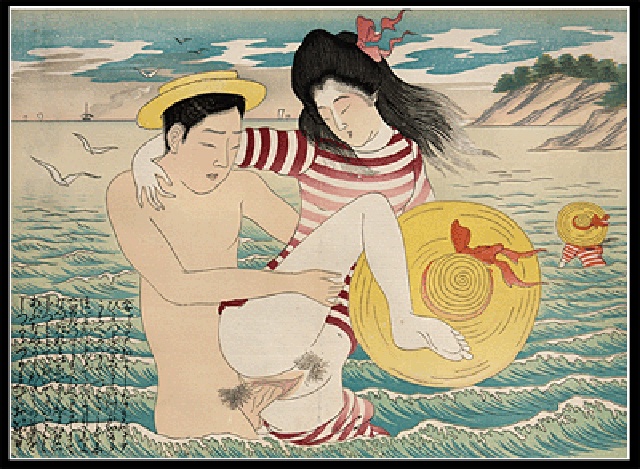
Shunga: Sex and Pleasure in Japanese art


Shunga is the taboo genre of erotic Japanese art. Whilst often considered vulgar or indecent, this exhibition at the British Museum sets Shunga in its historical context, seeks to explain why Shunga was made and who for and reveals its influence on modern art. When viewed in this context, one quickly becomes desensitised to the overtly erotic imagery and can appreciate this genre as a central part of life in Edo and as the art it was intended.

Shunga- which simply means Spring paintings- dates back to the 12th century, when it was hand painted on to large scrolls. It wasn't until the 17th century that artists began to use the ever so popular woodblock print to produce and reproduce their images.

Very early Shunga is quite simply beautiful. The scrolls in the show are incredibly detailed and show intricate patterns of fabrics that drape intimate couples. Whilst explicit sexually, they are also explicit artistically and incredibly beautiful. Other images from this period are far more crude. Particularly a painting depicting a penis measuring competition. The winner is anyone's guess as the men's bits are depicted as being ridiculously huge! As one artist from the period puts it  “if ‘the thing’ were depicted in its actual size there would be nothing of interest, for that reason don’t we say that art is fantasy?”


The woodblock prints allowed Shunga to develop and become mainstream. This led to a huge variety in the way Shunga looked and was used. Utamaro's series of prints that feature in the Poem of the Pillow, offer images presented in thin oblong aspects that the figures don't quite fit in to. It is a classic cropping technique borrowed from other ukiyo-e prints. If you can see the whole image, what is left is up to the imagination, the floating world. This makes the figures seem shyer and more intimate than earlier prints. Embarrassingly, it can also take a while to work out just what's going on in the image, and you can be rather taken aback when you finally work out what you have been staring at for five minutes.

The other genre within Shunga that woodblock printing led to was the satirical book. Many guidesw existed in Japan at this time for women, explaining how to be a good daughter or a good wife. One example used in the exhibition is a pamphlet that explains how to make rice noodles. The Shunga version shows a couple making love and explains the good wife's time would be better spent like this, than making noodles!

Shunga first reached western shores in the early 1600s. It was promptly burned for being so obscene. Once commodore Perry had negotiated trade with Japan and her ports had reopened to the west in 1853 however, Shunga flooded in. French artists in the 19th century were particularly taken with all things Japan and Picasso and Toulouse-Lautrec owned their own Shunga collection and its influence of their work is easy to spot.

In our modern world of the image and sexual liberation, we can still understand the shock of Shunga, yet can appreciate it as an artform. An exhibition well worth a visit.

Monday, 2 December 2013

New commute route? Probably not, but a great day out!


Any time one has visitors to London, it is expected one will provide a jam-packed itinerary of fun yet cultural and free yet 'touristy' activities for ones guests.

This time, I came up trumps. Thanks to our hosting of the 2012 Olympics, East London has undergone a wealth of redevelopment and improvement. We didn't go anywhere near that, but instead headed to Greenwich for its newest toy: The Emirates Skyline. This pretty useless addition to the TFL service is worth it's weight in gold when it comes to delighting visitors with views of London.

Even just buying tickets we were treated to an Anthony Gormley Sculpture. 


The 360 ride we opted for, takes you south of the River and back again, in what is about a 15 minute journey. I thought I was being ripped off when I learnt this would cost me £6.40, but the views were stunning and it was completely worth it. Freddie and Teddy Harry were kept entertained too, always worth however much that costs!


Although Freddie had soon had enough of sights, we were only just started! Another TFL money spinner, one that's usually more popular in the summer, granted, is the Thames Clipper. For just £5.85 on an oyster, it took us from North Greenwich to Westminster, via all the sights you could hope for. The vessel was bigger than I'd dared hope and even had a coffee bar so being too cold was luckily an unfulfilled fear.


Christmas wouldn't be Christmas without a Bavarian themed market. We got our fill on Southbank, then headed home. Ten out of ten for these forms of transport come sightseeing. More novel than a bus and warmer than walking. 


Sunday, 17 November 2013

Morris, after Watts


You'd be hard pushed to spend two hours getting from The National Gallery to Liverpool Street, even if you walked there with my Grandma and had given her a smartphone as only means of directing. That's exactly why I didn't do that, and opted instead for National Portrait Gallery Thursday lates in between work at the National Gallery and my netball match.

There's a lovely atmosphere in the NPG of a Thursday night. Dimmed lights, live DJ and, if you don't have to play sport in an hours time, drinks.

Instead, I pottered around the Victorian galleries and (badly) sketched G.F. Watts portrait of his friend and colleague, William Morris.

We lost at netball even though the other team were a man down. May as well have had a cocktail. Next time, I will.


Saturday, 16 November 2013

Georgians Revealed; Life, Style and the Making of Modern Britain

Tom and Jerry at the Exhibition of Pictures at the Royal Aacademy by Isaac Robert and George Cruikshank, 1821

Given how long exhibitions of this calibre take to organise- it contains over 200 original objects and paintings- it probably is coincidence that an exhibition of the last Georgian Age has coincided very nicely with the dawn of the next. I am talking of course about the birth of Prince George Alexander Louis Cambridge. It's very interesting to note that the cult of celebrity, interest in media coverage of events, need for spectacle and the desire to be oh-so-middle-England, all traits in the British public that were really made obvious by the event of Prince George's birth, were common in the British public of the first Georgian era.

This exhibition showcases the middle-class lifestyle in all of its elegant and sumptuous glory. Once you have walked through the first gallery that outlines the main social and political events of the era and, of course, introduces the four Georges and their wives, you are rewarded for hard work, as you should be, with a nice cup of tea!


In was in the Georgian period that serving this Eastern delight really became a fashionable affair. it wasn't as simple ass popping the kettle on, however. The Georgians even had a guide for polite conversation which should accompany the tea.

Once tea is over, every other aspect of Georgian day-to-day life and special events is covered. Robert Adam, the architects work is discussed, beautiful herbals illustrating botanical discoveries of the day are exhibited and the latest fashions are shown. Entertainment was a huge part of the Georgians' social life, demonstrated by circus posters, advertisements for balls and dances and the opening of Vauxhall and Kennington Pleasure Gardens. This inspired the cult of celebrity, with icons such as Grimaldi the Clown and actress Sarah Siddons. This lifestyle was captured by satirical artists of the day such as Cruicshanks and Hogarth, a wealth of their engraving work hangs in the exhibition.


The exhibition is so full of interesting artefacts which are beautifully exhibited. You simply don't get bored of looking and learning. The real treat is right at the end of the exhibition when you descend into Georgian London, by way of a huge map that covers the floor. Each area of the city is explained in its historical context, allowing you to really step back in time. A must see exhibition. 


Friday, 15 November 2013

TEN MINUTE TALK: Joseph Wright 'of Derby'


The title of this painting is purely descriptive and the artist has made no attempt to conceal the subject from us. As we look at the painting, the experiement in question dominates the picture space, it is right in the centre of the composition with both the bird and the air pump being immediately obvious. We can also see a group of people engaged in various ways with each other and the experiment they are watching. It is also immediately obvious that it is night time as we look into this scene; the moon is shining brightly into the candlelit room.


The airpump was invented in the 1650s by a German scientist named Otto von Guerick. It was an expensive piece of apparatus that would pump air out of whichever sealed chamber it was connected to, producing a vacuum. Due to its cost, the air pump was not readily available. The Irish Scientist Robert Boyle was very interested in experimenting with it and since he was the son of the Earl of Cork, the cost of the air pump was no obstruction to him. He experimented widely with the pump and in 1660, 9 years after he had established the Royal Society with 11 others, he published New Experiments, a volume detailing 43 experiments on the effects of different air pressure on various phenomena such as combustion, magnetism and even living creatures.


About a hundred years after Boyle’s experiments, when Joseph Wright painted this picture, air pumps were readily available and lectures and scientists would use them in public demonstrations, at fairs and in town halls and even, as Wright shows us in his painting, for middle class private audiences in their own home.


The experiment with the bird in the air pump was often the centrepiece for such shows, but was horrific to watch. Boyles book details the experiment and describes the bird’s slow suffocation as similar to watching poultry have its neck wrung.


This questions the importance of scientific discovery over the sanctity of life. Should the bird die so that people can learn about air pressure? Wright cleverly uses the audience of the experiment to raise society’s anxieties at the time over the impact of science.


The age of enlightenment, or the long 18th-century as it is sometimes known- refers to the period of rational and more secular thinking, teamed with scientific discover that occurred throughout the 1700s. Philosophers such as Locke would not accept any truths other than those which could be empirically proven to be true. He relied on what could be touched and seen. Scientists such as Isaac Newton were working to create theories that could be tested using science. People were worried about the impact of this on their lives and also on religion. Wright paints the young girls looking anxious for the bird, whilst the gentleman in the foreground comtemplate the outcome of the experiment. One can be seen timing how long it will take for the bird to die.


Wright has picked a crucial moment in the experiment. If it continues the girls’ fears will be realised and the bird will die, but if the experiment ends, then the bird will live. Write heightens the drama by giving the audience no real clue as to which outcome to expect. The bird pictured is a rare and expensive cockatoo. Usually a sparrow would have been used for such an experiment, so that maybe hints at the bird’s survival. However, we can also see the boy on the far right holding a pulley rope. It is impossible to tell whether this lowers the cage for the bird to be returned to it, or shuts the curtains on nature; blocking the natural light of the moon, leaving only illumination by science and a dead bird!


Some scholars have also hinted that this bowl of liquid holding a skull, through which the solitary candle can just be seen, acts as a vanitas, a technique of using objects which hint at the inevitability of death. Others have drawn attention to the image of the holy trinity in the painting made by the father character, the scientist and the bird. It is similar in composition to a holy trinity with Christ as the caring figure, tending to humans, the dove as the holy spirit and God the father, looking out at us and pointing to heaven.


In his looking out the figure of the scientist invites us in to the painting. Should the bird live or not, he appears to ask us. Testing on animals for scientific gain still causes contention between various religious, animal rights and scientific groups today.


Some art historians are less interested in the socio-political readings of the painting and focus on Wright’s technique. The dramatic subject lends itself well to the dramatic light in which Wright has made this painting. The stark contrast between light and dark, known in art historical terms as ‘chiaroscuro’ gives a definite realism to the painting. If we compare it to the Gainsborough just next to it, we can see how the painting is brought to life by the sharp contrasts in light and shadow.


I personally think that the fact Wright quite literally used science to enlighten the audience shows us that this painting does reflect the interest in science at the time it was painted.


Wright is referred to as Joseph Wright of Derby quite simply because that was the part of England he was from. He also studied in London, became an associate of the Royal Academy and painted portraits and landscapes in Liverpool and Italy. He had famous patrons such as Richard Arkwright and Josiah Wedgewood, showing him to be a thoroughly modern man. He was also famous for painting conversation pieces, popular in the 18th century with the middle classes, these paintings were portraits of recognisable people in real settings. Although Wright never claimed this painting was a conversation piece nor identified any of the characters in it, if you go through those doors into room 35 and turn left you will see a portrait of Wright’s friends Mr and Mrs Thomas Coltman who I think look suspiciously like the young couple here, who are a lot more interested in  each other than this experiment.


Friday, 8 November 2013

Eric Knowles and William Moorcroft; "I'm a potaholic!"


"I'm a pottaholic!" Exclaimed Eric Knowles, off of the Antiques Roadshow, at a conference in New York when introducing the History if Moorcroft Potters. It was with anecdote he began his talk last night at the De Morgan centre. Moorcroft established himself as a potter in Stoke -on-Trent a hundred years ago, following the success of his designs in the 1897 studio of James McIntyre. The Moorcroft reputation was fiercely and quite suddenly elevated to speciality status through a contract with Libery in the early 1900s. 


William Moorcroft, who started the firm, was a contempory of Morris an his circle and would have undoubtedly been influenced my De Morgan; another key figure in ceramics and art pottery of the time. The company is still alive and flourishing today. Much because of the influence of the still alive and flourishing Eric Knowles.