Thursday, 13 February 2014

Ten Minute Talk: Saint Margaret of Antioch, by Zurbaran


Today I will be giving a Ten Minute talk at the National Gallery in Room 30 on this wonderful Zurbaran Painting.

At the height of his career, Franciso de Zurbaran was a freeman of Seville, living there with his second wife, three children from his first marriage and eight servants. He had been invited by the town elders as they thought his distinction as a painter with dramatic Baroque flair and such daring chiaroscuro effect could boost the reputation of the town. Not only was that true, but it also boosted Zurbaran's career and he was appointed as court painter to Philip IV Spain.

Saint Margaret of Antioch was painted by Zurbaran in the 1630s, just before his career really took off. This makes it a rare and exciting painting. Zurbaran's most famous saint paintings are painted in series, such as the magnificent series of the 12 Sons of Jacob in the collection at Aukland Castle, and are painted by studio assistants, rather than solely by the artist himself.

Saint Margaret of Antioch was a peasant girl who lived in the third century in Antioch, a small town in Byzantium, modern-day Turkey. Her mother had died in her early childhood and she was raised by her shepherdess nurse, hence Zurbaran's inclusion of a crook in the painting. To aid identification further, Zurbaran dresses the girl in his painting as a Spanish peasant girl, her bag (an alfornja) and hat drawn from life; she doesn't appear ethereal, as Zurbaran's saints often do, she is a real girl. Saint Margaret's  declared her faith with a vow of chastity, which ultimately cost her her life. When proposed to, by a Governer of the Roman Empire, Margaret refused and was taken away for torture. One of her martyrdoms was to be fed to the devil disguised as a dragon. Her purity saved her and she burst from it's belly. This is symbolised by the beast crouching behind her in Zurbaran's painting. It is most unusual of Zurbaran's Baroque style to have depicted the saint as an ordinary, contemporary girl, with a tame dragon. The high drama and excitement of painting at this time would usually dictate a story of this magnitude be illustrated at crux of the tale, namely where Saint Margaret bursts from the dragon. This suggests it was painted at the patrons request. As she is the patron saint of childbirth (due to bursting from dragon) it could perhaps be intended as a tasteful wedding gift.

Despite his great fame and fortune, Zurbaran's style became rather unfashionable even during his lifetime, with the pastel tones and subtle lighting of Murrillo taking centre stage, and Zurbaran died in obscurity.

http://www.nationalgallery.org.uk/paintings/francisco-de-zurbaran-saint-margaret-of-antioch

Thursday, 6 February 2014

Men in Pants at the De Morgan Centre


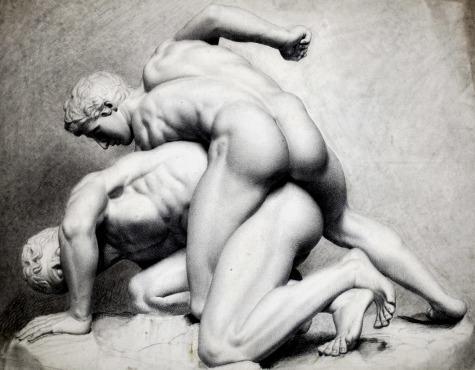
There's nothing quite like saying it how it is. Men in Pants is what they say you're going to get and it's exactly what you get in this fabulous exhibition at the De Morgan Centre. The focus is on a hitherto unexplored area of Evelyn De Morgan's work, her preparatory life drawings. She began her career at the Slade School of Art, one of three of the first women to be enrolled. There, she actively engaged in life drawing and drawing from sculpture. She meticulously studied the human form; both the nude and the dressed, which she would scrutinise to perfect her depiction of fabric falling over the body.

Seeing these drawings in the context of the largest collection of Evelyn's paintings allows for a fresh look at the collection. Her rigorous technique and planning of her paintings is better understood, when one can appreciate her conviction and execution of the piece. The works on paper are simply beautiful in their own right and really show off her higher understanding of how to manipulate light and line to stunning effects.

The De Morgan Centre, Wandsworth, until 26th April http://demorgan.org.uk/meninpants

Thursday, 23 January 2014

Seeing Double! Sunflowers Display at the National Gallery


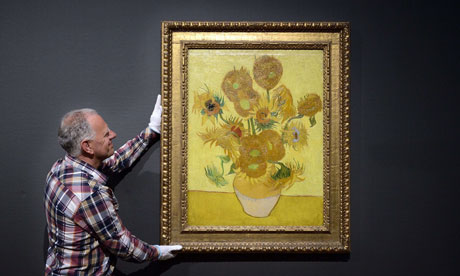
Today was a particularly exciting one at the National Gallery. It started with that same moment of tension you always feel when unpacking a painting that has arrived from another gallery: will it be ok? Will it be there at all?!

In this case, thankfully it was and we got the Van Gogh Museum, Amsterdam's, version of Van Gogh's Sunflowers on to the wall next ot ours for the first time in 60 years. The reunion is a result of a long working friendship with the Van Gogh Museum and a collaborative conservation and research programme. This has uncovered some exciting facts about the well-loved pair, such as the light blue in the Van Gogh Museum version would have been a dark purple when Van Gogh painted it, to decorate Gaugin's bedroom for his summer 1888 visit to Arles, just before Van Gogh's famous breakdown, that incident with the ear and his spell in an Asylum.

Given the popularity (5000 visitors in the first weekend!) it seems a shame we can't have all 5 surviving paintings from this series, but even just getting these two together has been enough work for one week!


Wednesday, 8 January 2014

Ten Minute Talk: Christ Blessing the Children, Nicholaes Maes


If you couldn't make my Ten Minute Talk at the National Gallery today, then you can read about the fab Maes painting here instead.

Nicholaes Maes is errornously best know as a successful pupil of the great Dutch master, Rembrandt. Indeed, research and publications pertaining to his work are often investigations meriting Rembrandt with being a great teacher.

Maes was born in Dordrect, the Netherlands, during the 80 Years War for Dutch independence from Spanish rule. It was a turbulent time, but one of increasing Dutch power; by the 1650s this was one of the richest, most powerful and influential nations. The Netherlands international trade, colonisation of land seafaring power made it the first successfully globalised nation. 

Independence from Spain, granted by King Philip II was granted in 1648. In addition to the power the country gained from this, the lives of ordinary people changed dramatically. Calvinism took over, making Catholic practice redundant. This religion's ideology is rooted in the truth of the word, taking the bible quite literally and living by the work of the scriptures. This was largely driven by Johannes Gutenberg's 1450 invention of the printing press, which increased book production by an unprecedented amount. Where as once a congregation relied on images of Christ and the Priest to tell the of the Bible under Catholicism, the Calvinist regime allowed them to read the bible for themselves. These new Protestant churches were sparsely decorated; huge halls of quite contemplation. For artists, this meant a shift in patronage, from the church to the middle class trader.

It can be supposed, given the size of the canvas, which appears to be two sheets glued together, that Maes' Christ Blessing the Children was indeed created for a wealthy merchant. Certainly, he never created anything as large after this piece. What is certain is that the subject matter, a highly provocative religious sentiment, was not typical of Maes. This could either point to a less than ideal patron early in Maes' career, or his dedication to the style of Rembrandt.

What we see here is a very clever and subtly persuasive depiction of Christ Blessing the Children, Matthew 19, 13:15. "Then people brought little children to Jesus for him to place his hands on them and pray for them. But the disciples rebuked them. Jesus said, “Let the little children come to me, and do not hinder them, for the kingdom of heaven belongs to such as these.” 

This text was used by Calvinists as reason for infant baptism, and allowed them to argue against the Lutharian view that only those capable of making the choice should be baptised into the Kingdom of Heaven. Their dedication to the word of the Bible as absolute truth, meant Calvinists did baptise their children, they thought it would relieve them from Original Sin, which Maes hints to with the girl in the foreground clutching the apple. 


Other characters in this painting help to tell a story. Later in his career, Maes would focus his work on portraiture and satirical depictions of everyday life. His interest in people and relationships, as opposed to a devout religious painting, is obvious here in the look of the crowd. Whilst Christ is portrayed as an ethereal, idealised being, the crowd are rugged and ordinary. Maes has clearly drawn from life to capture the essence of the working class crowd he depicts. Clever techniques he has employed are painting a strong middle ground of people, then filling in gaps behind them with a mere suggestion of an eye or an arm; it looks a lot busier than it is. In the top left corner, we can see a child clutching a peculiar object.


Given Maes' interest in people's lives, this is likely a spool of wool, which shows that the crowd is made up of Dutch spinners. In this traditional set up the father would be the weaver and work the loom to create wool cloth, the women or 'spinsters' would spin woollen yard and the infants were responsible for 'carding' or combing out the wool fibres from the raw wool. In their haste to run to Christ, this family has brought their work with them. In is another hint of the urgency and importance of becoming part of the church.

This is Maes' only large scale religious painting. When the National Gallery first acquired it, they did so as a Rembrandt, due to Maes' careful copying of his master's work. It is ironic, perhaps, given he is mainly remembered as Rembrandt's pupil, that Maes became famous and popular only when he moved away from Chiarascuro, murky, reds of Rembrandt to the fashionable, bright Baroque style he chose later in his career.


Tuesday, 10 December 2013

St Paul's Cathedral


There is no better time to visit the country's most important cathedral than at Christmas. sitting under the ordinarily superb dome whilst it's flanked by two impossibly large Christmas trees is just fabulous.

We took out an audio guide, which was wonderfully informative. The Old St Paul's was destroyed in the Great Fire of London in 1666. Redesigning the nation's church fell to the great Sir Christopher Wren, who was already busy changing the face of London with a collection of grand churches and buildings across the capital. With his signature Baroque elegance, wren's cathedral is just stunning. Whilst the outside is brilliant, it is the interior that sets it apart from others. In particular James Thornhill's frescos on the dome, depicting the life of St Paul, are impossibly brilliant. HOW did he get up their and paint them is all I could think whilst admiring them from the Whispering Gallery.

Even though it had already been a 257 step trak to this point, we were keen for the all-important view, so continued all the way up to the Golden Gallery, 528 steps up, to see it.


It is completely worth it!


Following a well earned tea and cake in the crypt, we stayed for a service of evensong, which was beautiful.


Walking home along Southbank


Saturday, 7 December 2013

Shunga: Sex and Pleasure in Japanese art


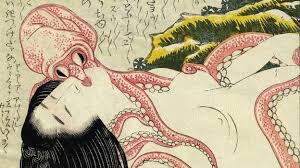
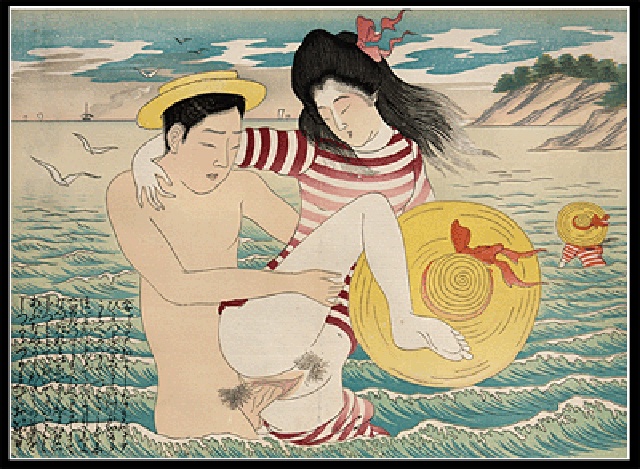
Shunga is the taboo genre of erotic Japanese art. Whilst often considered vulgar or indecent, this exhibition at the British Museum sets Shunga in its historical context, seeks to explain why Shunga was made and who for and reveals its influence on modern art. When viewed in this context, one quickly becomes desensitised to the overtly erotic imagery and can appreciate this genre as a central part of life in Edo and as the art it was intended.

Shunga- which simply means Spring paintings- dates back to the 12th century, when it was hand painted on to large scrolls. It wasn't until the 17th century that artists began to use the ever so popular woodblock print to produce and reproduce their images.

Very early Shunga is quite simply beautiful. The scrolls in the show are incredibly detailed and show intricate patterns of fabrics that drape intimate couples. Whilst explicit sexually, they are also explicit artistically and incredibly beautiful. Other images from this period are far more crude. Particularly a painting depicting a penis measuring competition. The winner is anyone's guess as the men's bits are depicted as being ridiculously huge! As one artist from the period puts it  “if ‘the thing’ were depicted in its actual size there would be nothing of interest, for that reason don’t we say that art is fantasy?”


The woodblock prints allowed Shunga to develop and become mainstream. This led to a huge variety in the way Shunga looked and was used. Utamaro's series of prints that feature in the Poem of the Pillow, offer images presented in thin oblong aspects that the figures don't quite fit in to. It is a classic cropping technique borrowed from other ukiyo-e prints. If you can see the whole image, what is left is up to the imagination, the floating world. This makes the figures seem shyer and more intimate than earlier prints. Embarrassingly, it can also take a while to work out just what's going on in the image, and you can be rather taken aback when you finally work out what you have been staring at for five minutes.

The other genre within Shunga that woodblock printing led to was the satirical book. Many guidesw existed in Japan at this time for women, explaining how to be a good daughter or a good wife. One example used in the exhibition is a pamphlet that explains how to make rice noodles. The Shunga version shows a couple making love and explains the good wife's time would be better spent like this, than making noodles!

Shunga first reached western shores in the early 1600s. It was promptly burned for being so obscene. Once commodore Perry had negotiated trade with Japan and her ports had reopened to the west in 1853 however, Shunga flooded in. French artists in the 19th century were particularly taken with all things Japan and Picasso and Toulouse-Lautrec owned their own Shunga collection and its influence of their work is easy to spot.

In our modern world of the image and sexual liberation, we can still understand the shock of Shunga, yet can appreciate it as an artform. An exhibition well worth a visit.

Monday, 2 December 2013

New commute route? Probably not, but a great day out!


Any time one has visitors to London, it is expected one will provide a jam-packed itinerary of fun yet cultural and free yet 'touristy' activities for ones guests.

This time, I came up trumps. Thanks to our hosting of the 2012 Olympics, East London has undergone a wealth of redevelopment and improvement. We didn't go anywhere near that, but instead headed to Greenwich for its newest toy: The Emirates Skyline. This pretty useless addition to the TFL service is worth it's weight in gold when it comes to delighting visitors with views of London.

Even just buying tickets we were treated to an Anthony Gormley Sculpture. 


The 360 ride we opted for, takes you south of the River and back again, in what is about a 15 minute journey. I thought I was being ripped off when I learnt this would cost me £6.40, but the views were stunning and it was completely worth it. Freddie and Teddy Harry were kept entertained too, always worth however much that costs!


Although Freddie had soon had enough of sights, we were only just started! Another TFL money spinner, one that's usually more popular in the summer, granted, is the Thames Clipper. For just £5.85 on an oyster, it took us from North Greenwich to Westminster, via all the sights you could hope for. The vessel was bigger than I'd dared hope and even had a coffee bar so being too cold was luckily an unfulfilled fear.


Christmas wouldn't be Christmas without a Bavarian themed market. We got our fill on Southbank, then headed home. Ten out of ten for these forms of transport come sightseeing. More novel than a bus and warmer than walking.