Wednesday, 2 December 2015

Poetry in beauty; Jan Marsh's latest Victorian Adventure


Poetry in Beauty


Jan Marsh is one of the world's leading experts on the Pre-Raphaelite Brotherhood and the women associated with the movement. Her most recent exhibition focusses on Marie Spartali Stillman and reassesses her oeuvre to show her as a great and diverse late-Victorian artist, who art history has until now resigned to the status of artists' muse. Spartali was a renowned Pre-Raphelite 'stunner' best know for her sittings with Rossetti, Whistler and Julia Margaret Cameron.

Spartali's (Stillman is her married name) work has previously been unknown to the art world, due to her prolific career and commercial appeal in the USA during her own lifetime. Through meticulous research Marsh has identified works by Spartali still held in private collections today and assigned these to known works shown at the cutting edge Grosvenor Gallery in London in the 1860s and 1870s.

In addition to the known, and classically Pre-Raphaelite, female half-length portraits which Spartali is perhaps best known for, exists charming landscapes from her travels in Italy with the great Italian painter Costa, church interiors and scenes from Greek mythology, such as her stunning study of Antigone.

Marsh said that Spartali's work was often rejected in her own time for being unfinished or overworked. Following up her ideas and notes in her diaries and letters however, shows that she was nothing short of a perfectionist and would always strive for a high level of finish and that it was this rather than any lack of ability which drove her to rework paintings.

An investigation of her account books with the art supplier Roberson's - now held in the National Portrait Gallery Archive - show that Spartali preferred to use a dense watercolour on panels and boards wrapped in paper, giving her work a unique luminosity, but also sadly responsible for the delicate condition of many of her works today.

Despite her extensive career in the USA, working in Philadelphia, Boston and New York, she was friendly with and aware of the work of the British Pre-Raphaelite circle, becoming grate friends with Janey Morris and drawing and painting Kelmscott Manor in the 1870s.

This fabulous exhibition, the cumulation of about five years' research, will be on show in Delaware until January 2016, when it will travel to the UK and go on show at the Watts Gallery in Surrey.


Friday, 13 November 2015

Ten Minute Talk: Wilkie's Young Woman at a Prayer Desk


Young Woman at a Prayer Desk, 1813
David Wilkie 
The National Gallery, Bought 2014

This is just the second painting to enter the National Gallery's collection, after Raeburn's The Archers. It is also one of the Gallery's most recent acquisitions, bought with a genourous gift left my Marcia Lay, a Birmingham teacher.

The Painting depicts Augusta Phipps, daughter of the 1st Earl Mulgrave. She looks out at us in her vulnerable position at her prayers as though we have interrupted this private moment. The tiny, intimate portrait was commissioned directly from the artist and has an incredible melancholy as Augusta died later that year.

Wilkie is one of Scotland's most eminent painters. Inspired in his early career by great Dutch masters, his paintings always capture the character of those in his paintings. His first great work, Pitlessie Fair was painted when he was just 19 years old. It draws on the work of greats such as Brueghel to depict an action packed market day and all of the associated commotion. It is packed with people buying and selling, gossiping, eating and drinking and there's even a urinating dog. As well as the commotion though, Wilkie captures the character of each individual. 

Pitlessie Fair, 1804
David Wilkie
National Galleries Scotland

Following this painting, Wilkie's career exploded. He was trained at the Royal Academy, follows Lawrence in becoming the King's Painter and Raeburn's in becoming the King's Limner in Scotland, to George IV, in 1830, followed by a knighthood in 1836, famed and favourited for his vast scenes and grand portraits.

It is in this tiny Vermeer-esque piece however, that his skill for details - the carpet is exquisitely executed, reminiscent of early Netherlandish realism - and capturing a moment with the sitter is really rather expertly shown.

Hear more in November 2015 Ten Minute Talks- Room 30, Friday's in November at 4pm

http://www.nationalgallery.org.uk/paintings/david-wilkie-a-young-woman-kneeling-at-a-prayer-desk


Pop! A juxtaposition

Tate's current EY exhibition The World Goes Pop reevaluates the Pop Art movement as an international one, rather than the western consumer culture phenomenon we are used to associating with Pop Art.

The spaces are devoid of Blakes, Warhols and Litchtensteins and replaced with works by Russian, Polish and Chinese artists who focus their work on exploring the effects of the Sovient Revolution and the Cold War.

Upon entering the exhibition you are completely overwhelmed by cartoon imagery and bright red walls which completely overwhelm.


Ushio Shinohara
Doll Festival 1966

Ushio Shinohara's Doll Festival 1966 is an enormous piece which forces - through it gaudy colours and block imagery - to consider 1960s materiality in an autonomous Chinese context.

There are lots of interesting works, but the exhibition does feel a little 'bitty' at times; almost like the curatorial concept is 'here's some Pop that's not by Hamilton'. The word juxtaposition features on every label and ultimately that is the idea behind the exhibition; it shows us them at the cartoon imagery of Pop can be used to address some pretty serious socio-political issues.

For £16 though you will get to see the world's weird and wonderful Pop from South America to the Middle East and back again.

Tate Modern until 24th January 2015

http://www.tate.org.uk/whats-on/tate-modern/exhibition/ey-exhibition-world-goes-pop


Tuesday, 11 August 2015

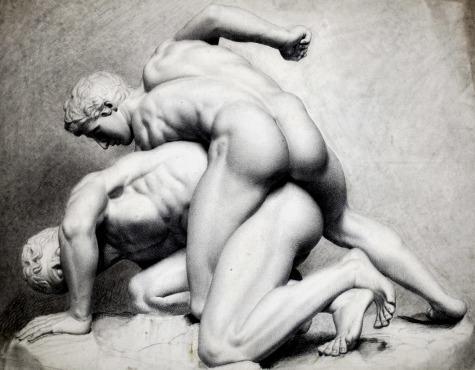
TEN MINUTE TALK: Degas' Young Spartans


National Gallery http://www.nationalgallery.org.uk/paintings/hilaire-germain-edgar-degas-young-spartans-exercising
Degas is best known as a painter of everyday life, who mastered a great range of media from oils to pastels.

This painting, however exemplifies Degas working within the tradition of historical painting; a much more mainstream and traditional subject taught at the academy at the time. Probably based of Plutarch's The Life of Sparta, the scene is the ancient Greek state of Sparta, with Mount Taygetos in the background, the legislator Spartan in the middle ground and the foreground is occupied with a  group of semi-naked and naked adolescents.

Sparta was a state obsessed with phyical perfection and so Degas occupies the picture space with these stretching posed youths, showing off their physical capabilities. So obsessed they were, that any inferior infant would be thrown off Mount Taygetos.

Whilst the subject would have been recognisable as traditional, the method Degas has employed is not. His brushwork is robust, but the paint is kept dry, giving a frieze like texture to the painting. The landscape orientation adds to this effect, showing Degas reference to the frieze objects of Classical civilization, as well as his knowledge of the stories. In addition, classical modelling and beauty is lost in this work and the youths appear more similar to 19th-century 'Montmartre types' rugged street children, something which has in the past drawn criticism.

A social history reading of this painting, put forward by Carol Salus, explains the composition of the group of youths as an investigation of Spartan courtship rites, rather than wrestling which is more commonly accepted by art historians.


Friday, 9 May 2014

Surprise! Rousseau's Tiger


The dense, sodden vegetation in the colourful foreground of this painting is stark and bright against the heavy, overbearing, thunderous sky. The more you look, the more you can feel the humidity of the rainforest, the painting not only looks like a jungle it entices you to feel the jungle around you. The question is that if the surprise, is the tiger surprised by the lightning, are we surprised by the tiger or are the hunters, hidden from view but suggested by the artist, surprised at becoming prey?

This oil was painted in 1891 by Henri Rousseau and was his first jungle painting, a genre which has become synonymous with his name. 

Rousseau was born in the market town of Laval in North West France in 1844. Much that is known about his life is shrouded in doubt, as he often lied about his experiences and jobs to impress his friends. What we can be certain of is that he enjoyed a normal family life and was educated in school until the age of 17. After this comes the lies- notably being forced to join the army when he was caught stealing money and cash from his job as a law clerk.

Following the success of his jungle scenes in later life, Rousseau would describe how his experience in Mexico as a regimental bandsman inspired the exotic flora and fauna, but Rousseau never left France.

He moved to a newly modernised Paris in 1868 and quickly married Clèmence Boitard. He had a child with her, who died in infancy and the marriage did not last.

He began working as a toll station inspector in 1871 and continued in the profession until he retired. Another case of Rousseau bending the truth to his advantage can be seen here. "le Douanier" means customs inspector and, dispute Rousseau readily adopting this nickname, it was a rank he never reached.

In 1880 Rousseau's first signed painting appear, depicting Parisian life and portraits of friends. He taught himself to paint and his own unique style is obvious. He allowed himself to be considered a naive painter, but he was certainly aware of academic technique and old master paintings, having taken out a copyist permit for the Louvre in 1884.

Surprise is Rousseau's first jungle painting. The vegetation is based on accurate knowledge and representation of flora Rousseau would have seen on trips to the Botanical Gardens in Paris. At the front he paints agave leaves and pointed euphorbia, a rubber plant, American fan palms and a French pinnate surround the tiger, whilst a java fig and India Bo Tree overhang the scene. The fact that all of these plants live naturally across three continents suggest again that the scene is based on the France that Rousseau saw, rather than the Mexico he lied about living in.

What is incredible though, is his accurate representation of the plants and instinctive use of colour, yet the dream-like quality he archives in his execution of the scene. He even said that "when I step into these hot houses and see strange plants from exotic lands I feel as if I have stepped into a dream".

Rousseau was consider naive by contemporary audiences and laughed at at the salon des independents where he exhibited but the avant-garde held him in high esteem. If you look closely at the original, the translucent, opalescent glaze he has applied in diagonal grey and white oil streaks across the canvas show his complex understanding of painting and his incredible skill. Again, 'naive' is probably a label the incredibly self assured artistes promoted himself.

Indeed, he used his paintings as evidence to win his acquittal when tried for fraud in 1907. So pleased was his friend Picasso, he held a soirée in honour of the occasion and claimed Rousseau was the greatest modern artist if his time.

Testimony to this are Weber's New York exhibition of his work just one year after his death.

Whilst Rousseau was a fraud and a chancer in so many ways, in so many others he was an artistic heinous who used prejudices and stereotypes to his great advantage. He would be incredibly smug to see his once-ridiculed painting hanging in such high esteem in the National Gallery today.

Wednesday, 30 April 2014

Writing KS2 lessons using Evelyn De Morgan's paintings

"The story of the Trojan War is one that has captivated generations. From its origins as Greek myth that taught of the destruction caused by the Gods’ meddling in the lives of mankind, to today’s ongoing questioning of the possibility Troy was real. The telling and retelling of The Trojan War, both as story and scientific investigation is a brilliant one to support the new History National Curriculum, which demands that children as young as KS1 can grasp the idea of the passing of time and the influence of one historical era on the next.
The myth itself is a thrilling tale of deceit, love, revenge and war. Eris, the Goddess of Strife and discord threw a golden apple addressed to the ‘fairest’ into a party of the Gods. Zeus sent Athena, Goddess of War, Hera the Queen of the Gods and Aphrodite, Goddess of Beauty and Love, to Paris, the son of Priam, the King of Troy, for him to judge. The Goddesses each offered him glory, but it was the promise of the most beautiful woman in the world that persuaded Paris to choose Aphrodite as the fairest and he handed her the golden apple.
True to her word, Aphrodite made Helen, the most beautiful of all the women, fall in love with Paris. Unfortunately, she was the wife of Menelaus, whose brother Agamemnon was the king of the Greek city of Mycenae. When Paris and Helen ran away to Troy together, Agamemnon led his troops to Troy and besieged the city for ten years as punishment for what Paris had done.
After a long, fruitless war the Greeks finally overthrew the Trojans with the Trojan Horse. This large wooden horse was built by the Greeks who hid their best army inside it and then pretended to sail away from Troy. Thinking they had won the long war, the Trojans celebrated by bringing the horse into their city. As they wheeled it through the city gates, the Greeks burst from it and destroyed the city, thus ending the war and the city.
This terrible and brutal end to a long-fought war can be seen in the background of this 1898 oil painting by Evelyn De Morgan. The true horror of the fight that De Morgan has chosen to depict, however, is the peril of Cassandra. A daughter of Priam, the King of Troy, Cassandra was served the great misfortune of enormous beauty and being loved by Apollo. She would not give in to his advances, even when he promised her the gift of prophecy. She took the gift, but would not succumb to Apollo, and so he twisted the gift so that her accurate prophecies would always be ignored.
Cassandra warned of the fall of Troy. She told the Trojans of their downfall and warned them not to lead the great horse in to the city. Her utter frustration and suffering is evident in De Morgan’s painting of her, as Troy burns, behind her just as she had foretold.
Pupils studying History at KS1 must learn the basics of what they will go on to study later in their academic careers. Learning the epic story of Troy is a fabulous way to engage the children with Greek Mythology, and using an object so easily readable, yet visually stimulating is an excellent way to introduce the myth. In addition, pupils can be taught that this painting was made in 1898, at the end of the Victorian period, much later than the myths. They can begin to see similarities and differences across time.
By KS2, pupils must study Ancient Greece and also an aspect or theme in British history that extends pupils’ chronological knowledge beyond 1066. Teaching pupils the legacy of Greek culture, art, architecture and literature on later periods in British history is easily achieved through this painting. As De Morgan was embarking on her painting career around 1870, archaeological exploration and discovery by the archaeologists Frank Calvert and Heinrich Schliemann, in Hissarlik in modern-day Turkey, led to a widespread interest in the possibility of Troy being real. This renewed excitement led to a great interest in the late-19th century of Greek arts and architecture, which may be a reason for De Morgan’s subject choice.
Another reason for De Morgan choosing this subject could have been the torment of Cassandra. Cassandra is made to pay for being beautiful with the curse of nobody listening to her. It is eerily reflective of the struggles faced by women at the end of the 19th and early 20th centuries, as they campaigned against objectification by men and for their own voice to be heard through the international campaign for Women’s Suffrage. Evelyn De Morgan was lucky, in her lifetime, to be educated and be free to follow an artistic career. She knew this and was an active campaigner for Women’s Suffrage. She has placed Cassandra, troubled and tormented, at the centre of the composition of her painting. She is telling of the fall of a nation because of the ignorance of women; it is really quite profound.

KS3 pupils must learn about the challenges for Britain, Europe and the wider world, 1901 to the present day.Women’s suffrage is a hugely important aspect of this, which is easily taught through De Morgan’s practice.
Ultimately, the passing of time and the placing of British history within world history can be overwhelming ideas to grasp. Using a vivid aesthetic starting point to tell a story that has lasted Millennia, is a particularly strong one. The fact this piece is both a primary source in itself, showing off the late-Victorian interest in Greek mythology in painting, and a secondary source, which depicts the ancient story of Cassandra, can help pupils to understand the depth of world history and the links between British and world history."

Monday, 10 March 2014

Martin Creed; What's The Point Of It?


What, indeed, is the point of a row of cacti, a ball of bluetac, a tower of loo rolls, a car on a roof or a room full of balloons? 

To entertain, to amuse, to provoke wonder, awe and disgust.

It's all here in Martin Creed's retrospective at the Hayward Gallery on the South Bank.

An artist who found fame by winning the Turner Prize for a room where the lights go on and off, is one I would usually write off and not bother with. But there was something just so intriguing about the idea of running around a room filled with balloons that I just had to visit. I didn't regret it. Each piece acts in harmony in this exhibit come installation. Every aspect is precision planned to ensure all your senses are engaged. There is a volunteer bashing the keys of a battered piano, toilet noises being played from an obvious speaker and even a cinema room playing clips of people making themselves vomit. Repulsive yet compelling.

The show, and indeed Creed's general line of enquiry, since his graduation from his Slade School days and throughout his career, probes us to answer questions of art.

Whilst this is a well-established trait of the avant-garde, I mean, Duchamp got there first with his urinal, it is the playfulness of Creed that makes his work so engaging. Ultimately, his coloured felt-tip drawings are simply quite beautiful, they have an unexpected yet genuine aesthetic quality.

"I don't know what art is"

"I wouldn't call myself an artist"

I don't think I would call him an artist either, and the show won't answer the eternal question of what art is. Creed is more a philosopher who asks his own questions in his own spectacular way.

A must see.

Thursday, 13 February 2014

Sensing Spaces at the RA


There's nothing that releases your inner child quite like being told 'yes, of course you can climb on the art work!' By an RA gallery assistant.

Sadly, the giddy excitement this initially filled me with, only lasted up a spiral staircase until the top of a pine cube, before the concept was old and the novelty expired.

In this huge architectural installation, we are asked to question materials and how they create the spaces around us and how we interact with them. A great idea, but the pieces themselves were just a little boring: some twigs with a light up floor and some long drinking straws I plaited and stuck in some corrugated plastic. It wasn't exciting and I forgot I was supposed to be intrigued. Diebedo Francis Kere, who came up with this claims to want to use architecture to 'respond to the users needs'. Well sadly, I was bored and you didn't entertain me!


Curator, Kate Goodwin, says this show should "encourage visitors to question their ideas about architecture and test its capacity to move them". Until I stepped into he Grafton Architects concrete structure room, I would say this exhibition had failed; but this installation is simply awe inspiring. It's not a half-cut attempt to show off your practices mission statement, nor overly playful. There is just a beautiful simplicity to walking under tonnes of vast, geometric concrete-esque plaster blocks. They are overpowering, quite literally as they hang over you, but subtle; you still see what's ahead, they are not obscuring your view. The play with light is superb and typical of Grafton's practice. They look at how structures sit in their surroundings and they alter a landscape, a practice which shines through, quite literally, in this installation. Go and see this exhibition just for the wonder of this piece.


Royal Academy, London, until 6 April 2014

http://www.royalacademy.org.uk/exhibitions/sensingspaces/


Ten Minute Talk: Saint Margaret of Antioch, by Zurbaran


Today I will be giving a Ten Minute talk at the National Gallery in Room 30 on this wonderful Zurbaran Painting.

At the height of his career, Franciso de Zurbaran was a freeman of Seville, living there with his second wife, three children from his first marriage and eight servants. He had been invited by the town elders as they thought his distinction as a painter with dramatic Baroque flair and such daring chiaroscuro effect could boost the reputation of the town. Not only was that true, but it also boosted Zurbaran's career and he was appointed as court painter to Philip IV Spain.

Saint Margaret of Antioch was painted by Zurbaran in the 1630s, just before his career really took off. This makes it a rare and exciting painting. Zurbaran's most famous saint paintings are painted in series, such as the magnificent series of the 12 Sons of Jacob in the collection at Aukland Castle, and are painted by studio assistants, rather than solely by the artist himself.

Saint Margaret of Antioch was a peasant girl who lived in the third century in Antioch, a small town in Byzantium, modern-day Turkey. Her mother had died in her early childhood and she was raised by her shepherdess nurse, hence Zurbaran's inclusion of a crook in the painting. To aid identification further, Zurbaran dresses the girl in his painting as a Spanish peasant girl, her bag (an alfornja) and hat drawn from life; she doesn't appear ethereal, as Zurbaran's saints often do, she is a real girl. Saint Margaret's  declared her faith with a vow of chastity, which ultimately cost her her life. When proposed to, by a Governer of the Roman Empire, Margaret refused and was taken away for torture. One of her martyrdoms was to be fed to the devil disguised as a dragon. Her purity saved her and she burst from it's belly. This is symbolised by the beast crouching behind her in Zurbaran's painting. It is most unusual of Zurbaran's Baroque style to have depicted the saint as an ordinary, contemporary girl, with a tame dragon. The high drama and excitement of painting at this time would usually dictate a story of this magnitude be illustrated at crux of the tale, namely where Saint Margaret bursts from the dragon. This suggests it was painted at the patrons request. As she is the patron saint of childbirth (due to bursting from dragon) it could perhaps be intended as a tasteful wedding gift.

Despite his great fame and fortune, Zurbaran's style became rather unfashionable even during his lifetime, with the pastel tones and subtle lighting of Murrillo taking centre stage, and Zurbaran died in obscurity.

http://www.nationalgallery.org.uk/paintings/francisco-de-zurbaran-saint-margaret-of-antioch

Thursday, 6 February 2014

Men in Pants at the De Morgan Centre


There's nothing quite like saying it how it is. Men in Pants is what they say you're going to get and it's exactly what you get in this fabulous exhibition at the De Morgan Centre. The focus is on a hitherto unexplored area of Evelyn De Morgan's work, her preparatory life drawings. She began her career at the Slade School of Art, one of three of the first women to be enrolled. There, she actively engaged in life drawing and drawing from sculpture. She meticulously studied the human form; both the nude and the dressed, which she would scrutinise to perfect her depiction of fabric falling over the body.

Seeing these drawings in the context of the largest collection of Evelyn's paintings allows for a fresh look at the collection. Her rigorous technique and planning of her paintings is better understood, when one can appreciate her conviction and execution of the piece. The works on paper are simply beautiful in their own right and really show off her higher understanding of how to manipulate light and line to stunning effects.

The De Morgan Centre, Wandsworth, until 26th April http://demorgan.org.uk/meninpants

Thursday, 23 January 2014

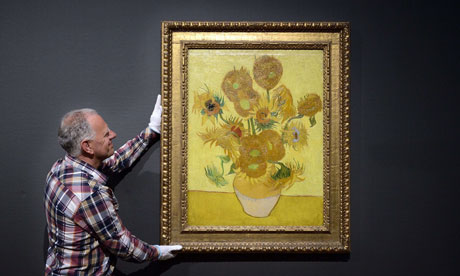
Seeing Double! Sunflowers Display at the National Gallery


Today was a particularly exciting one at the National Gallery. It started with that same moment of tension you always feel when unpacking a painting that has arrived from another gallery: will it be ok? Will it be there at all?!

In this case, thankfully it was and we got the Van Gogh Museum, Amsterdam's, version of Van Gogh's Sunflowers on to the wall next ot ours for the first time in 60 years. The reunion is a result of a long working friendship with the Van Gogh Museum and a collaborative conservation and research programme. This has uncovered some exciting facts about the well-loved pair, such as the light blue in the Van Gogh Museum version would have been a dark purple when Van Gogh painted it, to decorate Gaugin's bedroom for his summer 1888 visit to Arles, just before Van Gogh's famous breakdown, that incident with the ear and his spell in an Asylum.

Given the popularity (5000 visitors in the first weekend!) it seems a shame we can't have all 5 surviving paintings from this series, but even just getting these two together has been enough work for one week!


Wednesday, 8 January 2014

Ten Minute Talk: Christ Blessing the Children, Nicholaes Maes


If you couldn't make my Ten Minute Talk at the National Gallery today, then you can read about the fab Maes painting here instead.

Nicholaes Maes is errornously best know as a successful pupil of the great Dutch master, Rembrandt. Indeed, research and publications pertaining to his work are often investigations meriting Rembrandt with being a great teacher.

Maes was born in Dordrect, the Netherlands, during the 80 Years War for Dutch independence from Spanish rule. It was a turbulent time, but one of increasing Dutch power; by the 1650s this was one of the richest, most powerful and influential nations. The Netherlands international trade, colonisation of land seafaring power made it the first successfully globalised nation. 

Independence from Spain, granted by King Philip II was granted in 1648. In addition to the power the country gained from this, the lives of ordinary people changed dramatically. Calvinism took over, making Catholic practice redundant. This religion's ideology is rooted in the truth of the word, taking the bible quite literally and living by the work of the scriptures. This was largely driven by Johannes Gutenberg's 1450 invention of the printing press, which increased book production by an unprecedented amount. Where as once a congregation relied on images of Christ and the Priest to tell the of the Bible under Catholicism, the Calvinist regime allowed them to read the bible for themselves. These new Protestant churches were sparsely decorated; huge halls of quite contemplation. For artists, this meant a shift in patronage, from the church to the middle class trader.

It can be supposed, given the size of the canvas, which appears to be two sheets glued together, that Maes' Christ Blessing the Children was indeed created for a wealthy merchant. Certainly, he never created anything as large after this piece. What is certain is that the subject matter, a highly provocative religious sentiment, was not typical of Maes. This could either point to a less than ideal patron early in Maes' career, or his dedication to the style of Rembrandt.

What we see here is a very clever and subtly persuasive depiction of Christ Blessing the Children, Matthew 19, 13:15. "Then people brought little children to Jesus for him to place his hands on them and pray for them. But the disciples rebuked them. Jesus said, “Let the little children come to me, and do not hinder them, for the kingdom of heaven belongs to such as these.” 

This text was used by Calvinists as reason for infant baptism, and allowed them to argue against the Lutharian view that only those capable of making the choice should be baptised into the Kingdom of Heaven. Their dedication to the word of the Bible as absolute truth, meant Calvinists did baptise their children, they thought it would relieve them from Original Sin, which Maes hints to with the girl in the foreground clutching the apple. 


Other characters in this painting help to tell a story. Later in his career, Maes would focus his work on portraiture and satirical depictions of everyday life. His interest in people and relationships, as opposed to a devout religious painting, is obvious here in the look of the crowd. Whilst Christ is portrayed as an ethereal, idealised being, the crowd are rugged and ordinary. Maes has clearly drawn from life to capture the essence of the working class crowd he depicts. Clever techniques he has employed are painting a strong middle ground of people, then filling in gaps behind them with a mere suggestion of an eye or an arm; it looks a lot busier than it is. In the top left corner, we can see a child clutching a peculiar object.


Given Maes' interest in people's lives, this is likely a spool of wool, which shows that the crowd is made up of Dutch spinners. In this traditional set up the father would be the weaver and work the loom to create wool cloth, the women or 'spinsters' would spin woollen yard and the infants were responsible for 'carding' or combing out the wool fibres from the raw wool. In their haste to run to Christ, this family has brought their work with them. In is another hint of the urgency and importance of becoming part of the church.

This is Maes' only large scale religious painting. When the National Gallery first acquired it, they did so as a Rembrandt, due to Maes' careful copying of his master's work. It is ironic, perhaps, given he is mainly remembered as Rembrandt's pupil, that Maes became famous and popular only when he moved away from Chiarascuro, murky, reds of Rembrandt to the fashionable, bright Baroque style he chose later in his career.


Tuesday, 10 December 2013

St Paul's Cathedral


There is no better time to visit the country's most important cathedral than at Christmas. sitting under the ordinarily superb dome whilst it's flanked by two impossibly large Christmas trees is just fabulous.

We took out an audio guide, which was wonderfully informative. The Old St Paul's was destroyed in the Great Fire of London in 1666. Redesigning the nation's church fell to the great Sir Christopher Wren, who was already busy changing the face of London with a collection of grand churches and buildings across the capital. With his signature Baroque elegance, wren's cathedral is just stunning. Whilst the outside is brilliant, it is the interior that sets it apart from others. In particular James Thornhill's frescos on the dome, depicting the life of St Paul, are impossibly brilliant. HOW did he get up their and paint them is all I could think whilst admiring them from the Whispering Gallery.

Even though it had already been a 257 step trak to this point, we were keen for the all-important view, so continued all the way up to the Golden Gallery, 528 steps up, to see it.


It is completely worth it!


Following a well earned tea and cake in the crypt, we stayed for a service of evensong, which was beautiful.


Walking home along Southbank


Saturday, 7 December 2013

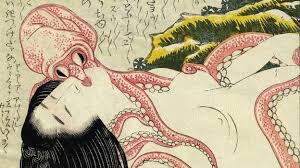
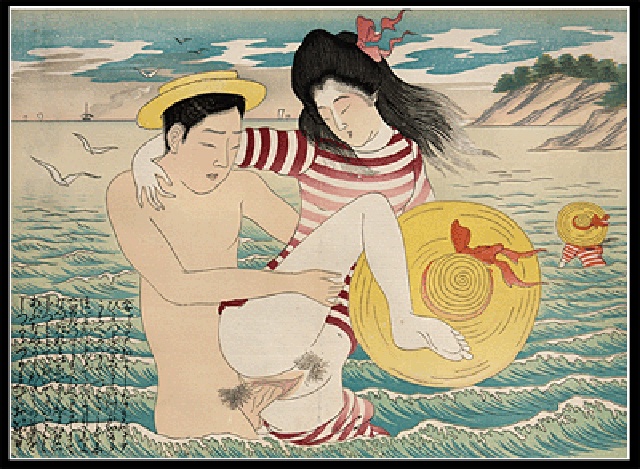
Shunga: Sex and Pleasure in Japanese art


Shunga is the taboo genre of erotic Japanese art. Whilst often considered vulgar or indecent, this exhibition at the British Museum sets Shunga in its historical context, seeks to explain why Shunga was made and who for and reveals its influence on modern art. When viewed in this context, one quickly becomes desensitised to the overtly erotic imagery and can appreciate this genre as a central part of life in Edo and as the art it was intended.

Shunga- which simply means Spring paintings- dates back to the 12th century, when it was hand painted on to large scrolls. It wasn't until the 17th century that artists began to use the ever so popular woodblock print to produce and reproduce their images.

Very early Shunga is quite simply beautiful. The scrolls in the show are incredibly detailed and show intricate patterns of fabrics that drape intimate couples. Whilst explicit sexually, they are also explicit artistically and incredibly beautiful. Other images from this period are far more crude. Particularly a painting depicting a penis measuring competition. The winner is anyone's guess as the men's bits are depicted as being ridiculously huge! As one artist from the period puts it  “if ‘the thing’ were depicted in its actual size there would be nothing of interest, for that reason don’t we say that art is fantasy?”


The woodblock prints allowed Shunga to develop and become mainstream. This led to a huge variety in the way Shunga looked and was used. Utamaro's series of prints that feature in the Poem of the Pillow, offer images presented in thin oblong aspects that the figures don't quite fit in to. It is a classic cropping technique borrowed from other ukiyo-e prints. If you can see the whole image, what is left is up to the imagination, the floating world. This makes the figures seem shyer and more intimate than earlier prints. Embarrassingly, it can also take a while to work out just what's going on in the image, and you can be rather taken aback when you finally work out what you have been staring at for five minutes.

The other genre within Shunga that woodblock printing led to was the satirical book. Many guidesw existed in Japan at this time for women, explaining how to be a good daughter or a good wife. One example used in the exhibition is a pamphlet that explains how to make rice noodles. The Shunga version shows a couple making love and explains the good wife's time would be better spent like this, than making noodles!

Shunga first reached western shores in the early 1600s. It was promptly burned for being so obscene. Once commodore Perry had negotiated trade with Japan and her ports had reopened to the west in 1853 however, Shunga flooded in. French artists in the 19th century were particularly taken with all things Japan and Picasso and Toulouse-Lautrec owned their own Shunga collection and its influence of their work is easy to spot.

In our modern world of the image and sexual liberation, we can still understand the shock of Shunga, yet can appreciate it as an artform. An exhibition well worth a visit.

Monday, 2 December 2013

New commute route? Probably not, but a great day out!


Any time one has visitors to London, it is expected one will provide a jam-packed itinerary of fun yet cultural and free yet 'touristy' activities for ones guests.

This time, I came up trumps. Thanks to our hosting of the 2012 Olympics, East London has undergone a wealth of redevelopment and improvement. We didn't go anywhere near that, but instead headed to Greenwich for its newest toy: The Emirates Skyline. This pretty useless addition to the TFL service is worth it's weight in gold when it comes to delighting visitors with views of London.

Even just buying tickets we were treated to an Anthony Gormley Sculpture. 


The 360 ride we opted for, takes you south of the River and back again, in what is about a 15 minute journey. I thought I was being ripped off when I learnt this would cost me £6.40, but the views were stunning and it was completely worth it. Freddie and Teddy Harry were kept entertained too, always worth however much that costs!


Although Freddie had soon had enough of sights, we were only just started! Another TFL money spinner, one that's usually more popular in the summer, granted, is the Thames Clipper. For just £5.85 on an oyster, it took us from North Greenwich to Westminster, via all the sights you could hope for. The vessel was bigger than I'd dared hope and even had a coffee bar so being too cold was luckily an unfulfilled fear.


Christmas wouldn't be Christmas without a Bavarian themed market. We got our fill on Southbank, then headed home. Ten out of ten for these forms of transport come sightseeing. More novel than a bus and warmer than walking. 


Sunday, 17 November 2013

Morris, after Watts


You'd be hard pushed to spend two hours getting from The National Gallery to Liverpool Street, even if you walked there with my Grandma and had given her a smartphone as only means of directing. That's exactly why I didn't do that, and opted instead for National Portrait Gallery Thursday lates in between work at the National Gallery and my netball match.

There's a lovely atmosphere in the NPG of a Thursday night. Dimmed lights, live DJ and, if you don't have to play sport in an hours time, drinks.

Instead, I pottered around the Victorian galleries and (badly) sketched G.F. Watts portrait of his friend and colleague, William Morris.

We lost at netball even though the other team were a man down. May as well have had a cocktail. Next time, I will.


Saturday, 16 November 2013

Georgians Revealed; Life, Style and the Making of Modern Britain

Tom and Jerry at the Exhibition of Pictures at the Royal Aacademy by Isaac Robert and George Cruikshank, 1821

Given how long exhibitions of this calibre take to organise- it contains over 200 original objects and paintings- it probably is coincidence that an exhibition of the last Georgian Age has coincided very nicely with the dawn of the next. I am talking of course about the birth of Prince George Alexander Louis Cambridge. It's very interesting to note that the cult of celebrity, interest in media coverage of events, need for spectacle and the desire to be oh-so-middle-England, all traits in the British public that were really made obvious by the event of Prince George's birth, were common in the British public of the first Georgian era.

This exhibition showcases the middle-class lifestyle in all of its elegant and sumptuous glory. Once you have walked through the first gallery that outlines the main social and political events of the era and, of course, introduces the four Georges and their wives, you are rewarded for hard work, as you should be, with a nice cup of tea!


In was in the Georgian period that serving this Eastern delight really became a fashionable affair. it wasn't as simple ass popping the kettle on, however. The Georgians even had a guide for polite conversation which should accompany the tea.

Once tea is over, every other aspect of Georgian day-to-day life and special events is covered. Robert Adam, the architects work is discussed, beautiful herbals illustrating botanical discoveries of the day are exhibited and the latest fashions are shown. Entertainment was a huge part of the Georgians' social life, demonstrated by circus posters, advertisements for balls and dances and the opening of Vauxhall and Kennington Pleasure Gardens. This inspired the cult of celebrity, with icons such as Grimaldi the Clown and actress Sarah Siddons. This lifestyle was captured by satirical artists of the day such as Cruicshanks and Hogarth, a wealth of their engraving work hangs in the exhibition.


The exhibition is so full of interesting artefacts which are beautifully exhibited. You simply don't get bored of looking and learning. The real treat is right at the end of the exhibition when you descend into Georgian London, by way of a huge map that covers the floor. Each area of the city is explained in its historical context, allowing you to really step back in time. A must see exhibition. 


Friday, 15 November 2013

TEN MINUTE TALK: Joseph Wright 'of Derby'


The title of this painting is purely descriptive and the artist has made no attempt to conceal the subject from us. As we look at the painting, the experiement in question dominates the picture space, it is right in the centre of the composition with both the bird and the air pump being immediately obvious. We can also see a group of people engaged in various ways with each other and the experiment they are watching. It is also immediately obvious that it is night time as we look into this scene; the moon is shining brightly into the candlelit room.


The airpump was invented in the 1650s by a German scientist named Otto von Guerick. It was an expensive piece of apparatus that would pump air out of whichever sealed chamber it was connected to, producing a vacuum. Due to its cost, the air pump was not readily available. The Irish Scientist Robert Boyle was very interested in experimenting with it and since he was the son of the Earl of Cork, the cost of the air pump was no obstruction to him. He experimented widely with the pump and in 1660, 9 years after he had established the Royal Society with 11 others, he published New Experiments, a volume detailing 43 experiments on the effects of different air pressure on various phenomena such as combustion, magnetism and even living creatures.


About a hundred years after Boyle’s experiments, when Joseph Wright painted this picture, air pumps were readily available and lectures and scientists would use them in public demonstrations, at fairs and in town halls and even, as Wright shows us in his painting, for middle class private audiences in their own home.


The experiment with the bird in the air pump was often the centrepiece for such shows, but was horrific to watch. Boyles book details the experiment and describes the bird’s slow suffocation as similar to watching poultry have its neck wrung.


This questions the importance of scientific discovery over the sanctity of life. Should the bird die so that people can learn about air pressure? Wright cleverly uses the audience of the experiment to raise society’s anxieties at the time over the impact of science.


The age of enlightenment, or the long 18th-century as it is sometimes known- refers to the period of rational and more secular thinking, teamed with scientific discover that occurred throughout the 1700s. Philosophers such as Locke would not accept any truths other than those which could be empirically proven to be true. He relied on what could be touched and seen. Scientists such as Isaac Newton were working to create theories that could be tested using science. People were worried about the impact of this on their lives and also on religion. Wright paints the young girls looking anxious for the bird, whilst the gentleman in the foreground comtemplate the outcome of the experiment. One can be seen timing how long it will take for the bird to die.


Wright has picked a crucial moment in the experiment. If it continues the girls’ fears will be realised and the bird will die, but if the experiment ends, then the bird will live. Write heightens the drama by giving the audience no real clue as to which outcome to expect. The bird pictured is a rare and expensive cockatoo. Usually a sparrow would have been used for such an experiment, so that maybe hints at the bird’s survival. However, we can also see the boy on the far right holding a pulley rope. It is impossible to tell whether this lowers the cage for the bird to be returned to it, or shuts the curtains on nature; blocking the natural light of the moon, leaving only illumination by science and a dead bird!


Some scholars have also hinted that this bowl of liquid holding a skull, through which the solitary candle can just be seen, acts as a vanitas, a technique of using objects which hint at the inevitability of death. Others have drawn attention to the image of the holy trinity in the painting made by the father character, the scientist and the bird. It is similar in composition to a holy trinity with Christ as the caring figure, tending to humans, the dove as the holy spirit and God the father, looking out at us and pointing to heaven.


In his looking out the figure of the scientist invites us in to the painting. Should the bird live or not, he appears to ask us. Testing on animals for scientific gain still causes contention between various religious, animal rights and scientific groups today.


Some art historians are less interested in the socio-political readings of the painting and focus on Wright’s technique. The dramatic subject lends itself well to the dramatic light in which Wright has made this painting. The stark contrast between light and dark, known in art historical terms as ‘chiaroscuro’ gives a definite realism to the painting. If we compare it to the Gainsborough just next to it, we can see how the painting is brought to life by the sharp contrasts in light and shadow.


I personally think that the fact Wright quite literally used science to enlighten the audience shows us that this painting does reflect the interest in science at the time it was painted.


Wright is referred to as Joseph Wright of Derby quite simply because that was the part of England he was from. He also studied in London, became an associate of the Royal Academy and painted portraits and landscapes in Liverpool and Italy. He had famous patrons such as Richard Arkwright and Josiah Wedgewood, showing him to be a thoroughly modern man. He was also famous for painting conversation pieces, popular in the 18th century with the middle classes, these paintings were portraits of recognisable people in real settings. Although Wright never claimed this painting was a conversation piece nor identified any of the characters in it, if you go through those doors into room 35 and turn left you will see a portrait of Wright’s friends Mr and Mrs Thomas Coltman who I think look suspiciously like the young couple here, who are a lot more interested in  each other than this experiment.


Friday, 8 November 2013

Eric Knowles and William Moorcroft; "I'm a potaholic!"


"I'm a pottaholic!" Exclaimed Eric Knowles, off of the Antiques Roadshow, at a conference in New York when introducing the History if Moorcroft Potters. It was with anecdote he began his talk last night at the De Morgan centre. Moorcroft established himself as a potter in Stoke -on-Trent a hundred years ago, following the success of his designs in the 1897 studio of James McIntyre. The Moorcroft reputation was fiercely and quite suddenly elevated to speciality status through a contract with Libery in the early 1900s. 


William Moorcroft, who started the firm, was a contempory of Morris an his circle and would have undoubtedly been influenced my De Morgan; another key figure in ceramics and art pottery of the time. The company is still alive and flourishing today. Much because of the influence of the still alive and flourishing Eric Knowles.


Thursday, 24 October 2013

Elizabeth I & Her People


Elizabeth I's reign is defined by the lives of those she reigned over. During her time cities boomed, the economy flourished and the world became that little bit less daunting thanks to successful exploration and trade.

This exhibition at the portrait gallery aims to convey the impact and success of the Queen, based on the people responsible for these endeavours. At first, it seems promising. We encounter hand-tinted maps and plans of London and grand portraits depicting the Queen's coronation. The curators even point out those people in the crowd who were responsible for her success as a monarch.

As we move forward, we are treated to a room dedicated to the image of Queen and how her people grew to recognise her. There is a lovely display of otherwise seldom seen portraits, a divine Frederick Zuccaro sketch and a selection of coins. This draws upon the relationship of the people to the Queen. The real focus of the exhibition- how those close to the Queen rose in power- is best demonstrated with portraits and artefacts in the third room. Elizabeth Talbot, Bess of Hardwick, William Cecil, Sir Walter Raleigh and the Duke and Duchess of Norfolk are all displayed, telling the story of how either charming or impressing the Queen could lead to vastly improved social standing.

After this, the exhibition goes downhill. The organisers have hereafter attempted to show the lives of the ordinary and how they were lived throughout Elizabeth's reign. Too much information, with not enough space or material to back it up, is added on to the end of the modestly sized exhibition almost as an after thought. You feel as though they should have stuck to telling us about the rich and powerful, which would have been interesting in itself. The rushed ending leads to huge oversights, such as William Tyndale, champion of the bible of the people, who gave the word of God to the Elizabethans, being omitted.

Despite this, the portraits are truly charming and give a real feel for the age. In particular the portrait of three Elizabethan children with their exotic pets, shows off beautifully the fashion for Dutch paintings and the impact of trade, as the children clutch their furry and feathered friends!