Showing posts with label Yorkshire Sculpture Park. Show all posts

Wednesday, 18 April 2012

David Hockney R.A.; A Bigger Picture


Of all the exhibitions I saw recently whilst in London, the retrospective of David Hockney's Landscapes at the Royal Academy was leaps and bounds ahead of the others. Hockney is from Bradford and after a long stretch of his work representing the wealth and leisure of California, where he lived a while, he returned to the Yorkshire countryside. The Yorkshire Hockney depicts is a far cry from the grey-purple rolling hills I see when I visit, yet feel strangely nostalgic. Created between 2004- 2011, Hockney used a range of media to re-visit Yorkshire and it is a powerful, colourful journey that his art takes you on.

What struck me first, and continuously throughout the exhibition, was Hockney's use of colour. Like I said, Yorkshire never looked this bright to me. Hockney is no realist though, his art doesn't tell you what's there, it captures how you feel. The striking colour is a celebration of the countryside, the unspoilt land and the power of nature. The Thixendale Trees show the same scene in four seasons. These enormous images use the motif of the tree through different life stages to show the passing of time and the recurrence of themes- fitting for a retrospect.

As well as celebrating nature, Hockney embraces new media. Famous for his experiments with photography and film earlier in his career, Hockney uses this retrospective to look beyond the acceptability once more and shows a series of images he created on his iPad. It is impossible to think of these images as anything but artistic genius when they are seen, reinstating Hockney as the master of the new.

My Grandma lives in Haworth, nestled in the Yorkshire Moors. I can empathise with Hockney's desire to show off the beautiful countryside from these parts. I did worry though, that showing off Yorkshire as an idyllic symbol of rural life, in fine galleries at the Royal Academy, is potentially quite ignorant of an area of the country which is in dire financial straits. His depiction of Saltaire, a once glorious town at the height of the Industrial Revolution, bears not mark of the horrors of unemployment faced by the redundant workforce of the failed manufacturing industry. Instead, this painting shows Saltaire Mills as a proud site of Industrial heritage.
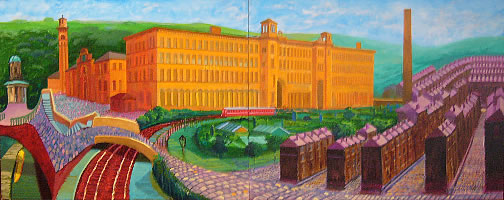


Proud is a good way to sum up the exhibition in fact. Hockney is clearly proud of his heritage and his country side, and for giving art back to the North, I'm proud of him. I certainly left the gallery feeling extremely smug to have thought 'I know where that is!' on my way around the exhibition.


http://www.royalacademy.org.uk/exhibitions/hockney/

Sunday, 18 September 2011

Yorkshire Sculpture Park


With summer days somewhat limited in the North of England, I leapt at the opportunity to visit what is essentially the best outdoor sculpture galleries in the country. It is an absolutely unique way to experience modern and contemporary sculpture in 500 acres of stunning Yorkshire dales.

What instantly appealed was the interaction between art and nature that was on offer. Barbara Hepworth and Henry Moore are two of the key benefactors to the park. Their work feels really quite at home nestled into the landscape which shaped their practice (both were educated at Leeds School of Art, where they first met).


One of my favourite pieces was Héros de Lumière by Polish sculptor, Igor Mitoraj. He uses classical ideals and materials in this piece, to produce what looks like a perfect marble replica of the work of Michaelangelo. However, there are some very obvious differences between a classical marble sculpture and this 1986 creation. Whilst classical pieces were made to perfection, Mitoraj has purposefully carved half of a woman's face, questioning classical ideas of perfection. The sheer size of this piece is also overwhelming. Icons and sculptures in antiquity were often larger than life to make them imposing or more valuable as a larger single block of marble would have to be carved. Mitoraj's example is magnified way beyond any classical sculpture would be which gives it a playful, surreal element that once again questions classical ideals and proportions.

I had first seen the work of Jaume Plensa in Nice whilst touring France. Whilst I had not remembered his name, his art work was unmistakeable. Plensa's caters for the public; creating art for the public, to go in public places. He is particularly interested in the interaction of people with the spaces around them and aims to manipulate this relationship with his work. I saw first-hand how alluring his pieces were and how they physically forged people with their surroundings when I tripped over a bollard in an attempt to get this photo of his sculpture in the south of France.
My second encountered of Plensa's work was thankfully injury free and very enjoyable. His huddled figures appear robust, yet insecure and represent the range of human emotion. Placing them in very public arenas forces the audience to interact with them and explore their own feelings. I particularly like the large suspended gongs engraved with emotive text that I was invited to bang. It was quite therapeutic to fill an otherwise empty gallery with the gentle hum of human existence.

As well as a wealth of engaging and though provoking exhibitions, the park, lake and Bretton Hall House are absolutely stunning and provide an experience of art, public art and sculpture that is very thought provoking indeed.